TL;DR
- •The old web ran on a trade. Sites let search engines crawl them, search sent human readers back, and the site sold ads. AI answer engines crawl the same way but keep the answer, so the reader never follows and the revenue dries up.
- •So sites want to charge the bot at the door. AWS, Cloudflare, Coinbase and Google are all building a tollgate on one old idea: the
HTTP 402 Payment Requiredresponse. The bot asks for a page, the site asks for money first. - •AWS has shipped its tollgate. It runs on Coinbase's x402 with crypto (USDC) settlement. The popular "AWS plus Stripe" line is wrong for now, Stripe support is marked coming soon, not live.
- •Who is paying today? Mostly the AI labs, through licensing deals, not the new tollgate. Reddit has booked $203M in content deals; OpenAI guaranteed People Inc. $16M; Perplexity set up a $42.5M publisher payout. The per-page toll is built and waiting.
- •The big transaction numbers are misleading. Coinbase's x402 passed 100M transactions, but most were a crypto fad, not agents buying things. The one genuinely huge real deployment is Alipay in China: 300M-plus transactions.
- •Verdict: the plumbing is real and live. The demand for the content tollgate is not there yet. The infrastructure is ready before the agents are, on purpose.
The deal that broke
For thirty years the web ran on a simple trade. A site let search engines crawl it for free, and in return search sent readers. Those readers saw ads or signed up for subscriptions. The crawl cost a little bandwidth and paid the site back in traffic. The arrangement held.
AI answer engines broke that trade. The bot still crawls the page, the machine still shows up, that part has not changed. What stops showing up is the human reader. The AI reads the page, writes the answer inside its own chatbot, and the person who asked gets what they needed without ever clicking through to the source. The crawl still costs the site bandwidth, but no reader follows it, so there is no ad to show and no subscription to win. The content was served and earned nothing.

This is not a small effect. AWS says AI bots now make up more than half of web traffic for many content providers, and AI-specific crawlers grew more than 300 percent year over year. Cloudflare, which sees about a fifth of the web, recently put a date on the tipping point: bots passed humans for the first time, 57.5 percent of HTML requests against 42.5 percent, a crossover its own CEO had not expected before late 2027. That has pushed publishers to an obvious question: if the bot takes the content but sends no readers back, can the bot at least be charged for the content?
The fix: charge the bot at the door
The fix the industry landed on is a tollgate, built on a piece of the web that has existed, unused, for decades. Every web response carries a status code. 200 means here is the page. 404 means not found. One code was always reserved for another case: 402 Payment Required. It sat idle because there was no standard way for a machine to actually pay. That is the gap these new systems fill.

The flow is the same everywhere. A bot asks for a page. Instead of handing it over, the site replies with a 402 and a small machine-readable note: the price, and where to pay. The bot pays, and the site delivers the page. The only real difference between the competing systems is what the bot pays with, crypto stablecoins in some, ordinary cards and bank payments in others, and who collects the money on the publisher's behalf.
What AWS actually built
AWS added this tollgate to its Web Application Firewall, the security layer that already sits in front of millions of websites. A site owner turns on a Monetize rule, and when a paying-eligible bot arrives, AWS returns the 402 with a short price list. A new dashboard breaks traffic into human, search, AI, and unknown, and shows what each costs to serve. The pitch is plain: stop giving the bytes away and start charging for them, without touching application code.
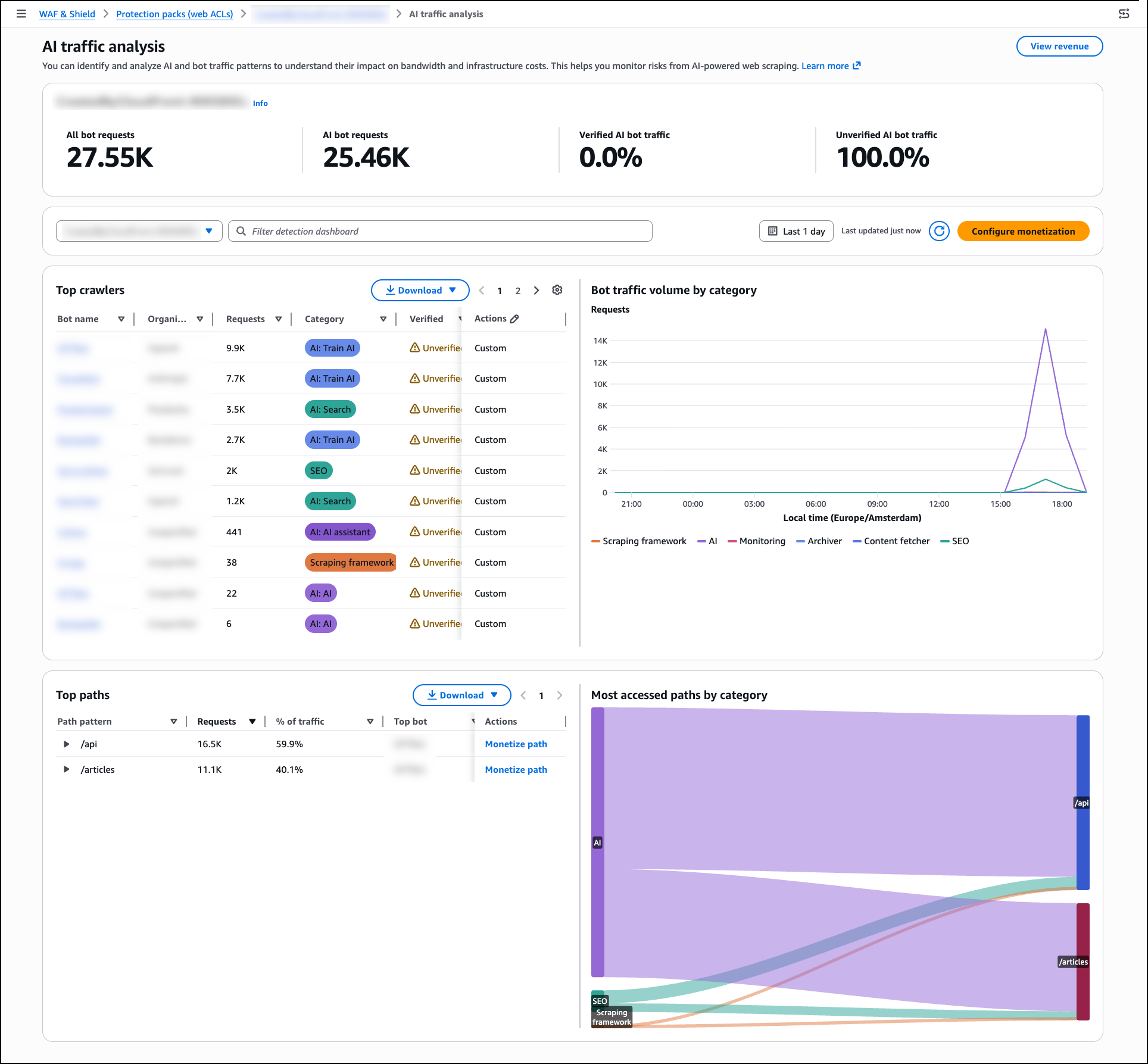
The detail most coverage gets wrong is the rail. At launch, the only way the money actually moves is Coinbase's x402, settling in the stablecoin USDC to a crypto wallet the content owner controls. AWS's own post says support for Stripe and its Machine Payments Protocol is "coming soon." So the common "AWS WAF runs on Stripe" framing is a roadmap item, not the launch reality. Today it is crypto rails, which for most marketing and content teams means a crypto wallet is required to collect, a real friction point.
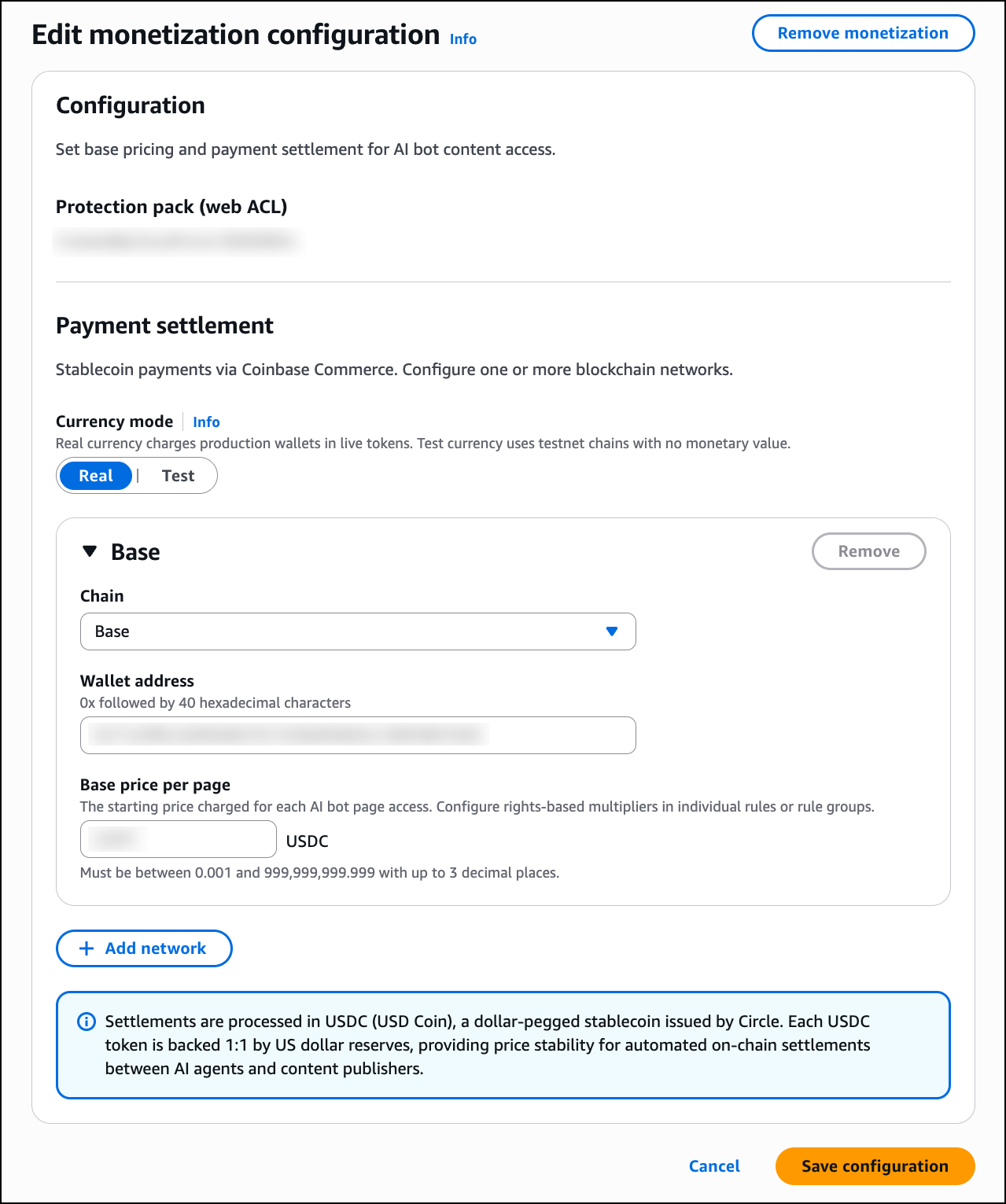
What AWS got right is distribution: it turned the tollgate into a checkbox on infrastructure sites already run. What it has not shown is a single number, no count of publishers charging, no revenue. The capability is real. Whether anyone is paying through it is a separate question, addressed below.
Everyone is building a version
AWS is not alone. The same idea is being built by the CDNs, by a payments giant, and by the platforms that want agents to buy things, not just read them. It helps to split them into two groups: those charging a bot to read content, and those letting an agent pay for goods and services. They share the 402 tollgate; they differ on everything else.
| Who | What it does | Pays with | Status |
|---|---|---|---|
| AWS WAF | Charge bots for content at the firewall | Crypto (USDC); Stripe soon | Live, Jun 2026 |
| Cloudflare Pay Per Crawl | Block AI crawlers by default, charge to enter | Cards and bank (Cloudflare collects) | Private beta, Jul 2025 |
| TollBit | Marketplace where AI labs pay publishers | Standard billing | Live, thousands of sites |
| Coinbase x402 | Pay-per-request for any page or API | Crypto (USDC) | Live, May 2025 |
| Stripe MPP | Let an agent pay any endpoint, with Tempo | Crypto and cards | Live protocol, Mar 2026 |
| Google AP2 | Rules for an agent to buy on a user's behalf | Cards, bank, crypto | Live, Sep 2025, 60+ partners |
| Alipay AI Pay | Agents pay merchants in China | Alipay accounts | Live at scale |
Two names are worth a closer look. Cloudflare sits in front of roughly a fifth of the web, so when it flipped its default to block AI crawlers unless they pay, it changed the bargaining position of every site behind it. Google's AP2, the Agent Payments Protocol, launched in September 2025 with more than 60 partners including Mastercard, PayPal, Amex, Coinbase and Salesforce. AP2 is not a content toll; it is a rulebook for letting an agent buy on a user's behalf, recording what the user approved, what the agent picked, and what was charged, so a merchant can trust the purchase. It even has a crypto extension built with Coinbase. Google's bet is on agents buying, which connects to the in-browser action surface covered in Inside WebMCP.
There is also a fast-growing layer beneath all of this: startups whose whole job is to give an agent an identity and a wallet so it can pay at all. Skyfire issues an agent a verified identity and a spending wallet behind a "Know Your Agent" check, the agent equivalent of the bank KYC process for humans, and late in 2025 demoed an agent buying off Bose.com using Visa. Catena Labs, started by a Circle co-founder who helped create the USDC stablecoin, raised a $30M Series A in 2026 to build what it calls an AI-native bank for agents, where the human sets the spending limits and the agent moves the money. These are the on-ramps that make the tollgates usable.
And the toll camp is consolidating, not fragmenting. In late 2025 Cloudflare and Coinbase co-founded the x402 Foundation to make x402 the shared standard, which is exactly why AWS, Cloudflare and Coinbase all speak the same 402 language. On the buy-side, the card networks moved too: Visa Intelligent Commerce, Mastercard Agent Pay, and PayPal checkout inside ChatGPT and Perplexity, broken down in the weekly briefing.
So who is actually paying today?
This is the question that cuts through the hype, and the answer is specific. AI companies are paying for content today. But almost none of it flows through the new per-page tollgate. It flows through old-fashioned licensing deals, big lump sums negotiated between an AI lab and a large publisher.
Real money changing hands now
$203M
Reddit, total content licensing deals booked
$16M
OpenAI's guaranteed minimum to People Inc.
$42.5M
Perplexity's publisher revenue-share pool
$10M
Microsoft's data-access fee to Informa
$5M to $60M
Per-year deals with AP, FT, News Corp, Axel Springer
~7,000
Publisher sites on the TollBit marketplace
The shape of that money is telling. It is a handful of large publishers signing direct deals, plus a marketplace (TollBit) that has gathered thousands of smaller sites and pays out from hundreds to tens of thousands of dollars a month. That is real revenue. But it is not the per-request, agent-pays-at-the-door model AWS and Cloudflare built. It is the AI labs paying upfront for the right to train and answer.
The summary, then: the tollgate is ready, but the cars are not lining up at it yet. The 402 toll exists, works, and is one checkbox away on AWS and Cloudflare. The payment volume that exists today mostly came through the older licensing door. The infrastructure was built ahead of the demand, the expected pattern when every major player is racing to own the standard before agents arrive in force.
The transaction numbers, and which are real
Headlines carry giant transaction counts. The counts are real; what they measure is the question. Two are worth knowing in detail, plus the content side most coverage skips.
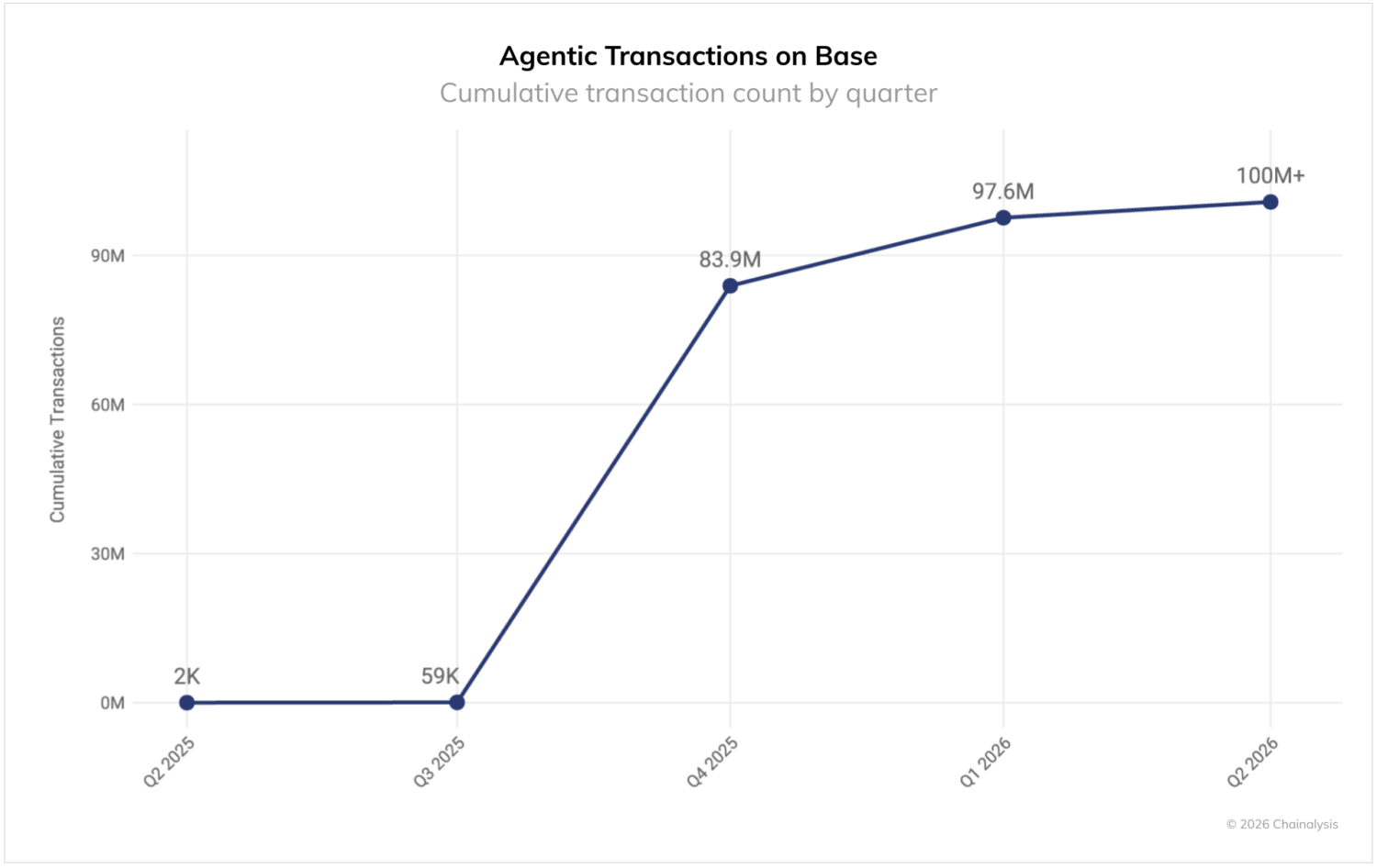
Coinbase x402: 100M-plus transactions, mostly speculation. On-chain data from Chainalysis shows x402 going from 2,000 cumulative transactions in mid-2025 to more than 100 million by mid-2026, with almost all of it landing after Q4 2025.
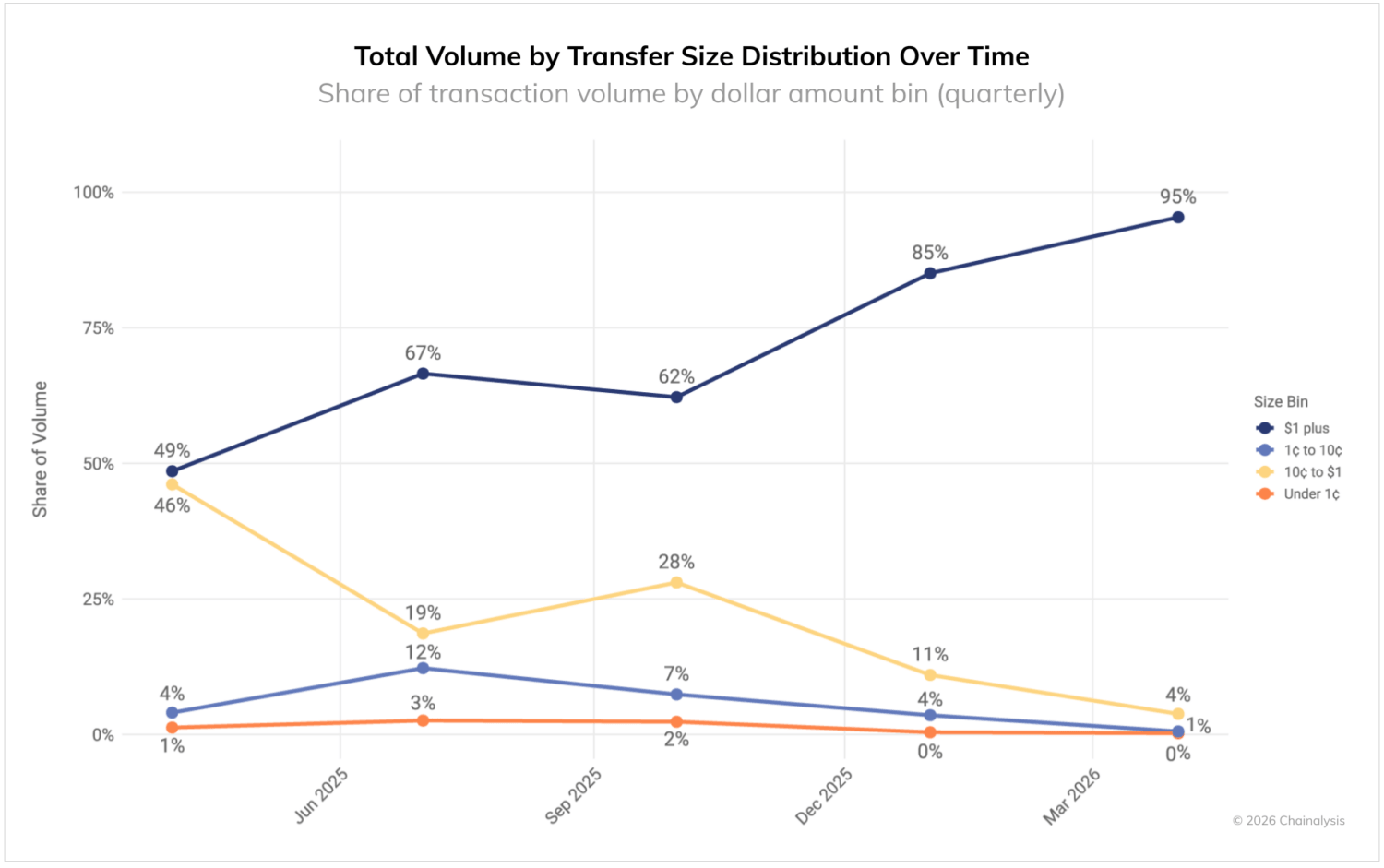
The catch is in the mix. Genuine micropayments, the 10-cent to 1-dollar range an agent paying per page or per call would use, collapsed from 46 percent of volume in early 2025 to just 4 percent by early 2026, while transactions of a dollar or more rose from 49 percent to 95 percent. The surge was led by PING, a token minted by paying 1 USDC over and over, which alone did more than 150,000 transactions in its first month. The typical x402 payer also looks like a crypto trader, not a content-buying agent: they hold about 26 different tokens, against 4 for a normal Base wallet. A separate on-chain check put daily volume at roughly $28,000, down about 92 percent from its December 2025 peak, against a protocol ecosystem valued near $7 billion. The 100 million count is real. Calling it agentic commerce is not.
The content side has fewer transactions but harder leverage. Cloudflare sits in front of roughly a fifth of the web, and by its own measure AI engines return almost no traffic: earning a referral is about 750 times harder from OpenAI and roughly 30,000 times harder from Anthropic than it was from the old Google, per Cloudflare. That gap is the whole case for the toll. What Cloudflare has not published, a year after launch, is a single marketplace number: no transaction count, no revenue.
Alipay AI Pay: 300M-plus transactions, the only real benchmark. In China, Ant Group's AI Pay passed 100 million users and 120 million transactions in a single week in February 2026, and 300 million-plus in total by late May, which Ant calls the first commercially scaled AI-native payment infrastructure. This is real consumer use: agents ordering inside apps for Luckin Coffee, payments through Rokid smart glasses, and integration with Alibaba's Qwen models. The figures are Alipay's own, but the headline numbers were corroborated by the payments outlet PYMNTS. The takeaway for US and EU markets: the one place agentic payments are unambiguously at scale is China, not the West.
Verdict: the rails are ready before the agents
Is agent monetization real or a theory? Real. The tollgates are live, the payment standards work, and money is moving. None of this is a slide deck.
But the honest read is that the build ran ahead of the demand. The per-page content toll, the AWS and Cloudflare model, is ready and waiting for buyers who have not arrived in volume. The real content money today comes through old licensing deals. The huge crypto transaction counts are mostly a fad. The one place real agent payments happen at scale is China. Even a Coinbase-backed effort admitted in March 2026 that the demand "is just not there yet."
That gap is the story. The infrastructure was built first on purpose, so that whoever owns the standard is positioned when agents do start paying at volume. The settled question is the plumbing. The open question is the behavior.
What to do about it
For content owners, the toll is a lever to hold, not pull yet. Charging a bot only works when the content is worth paying for and an agent cannot get a good-enough version free elsewhere. A few large publishers can command licensing deals; most sites cannot, and a hard paywall only makes a site invisible to the AI answers its customers now read. The safer near-term play is to be the source the agent picks, clear, structured, easy to cite, and keep the toll in reserve for when demand catches up.
The deeper point for marketing and analytics teams: this is the same decision as discovery inside answer engines, seen from the other side. A brand can be paid for access, or paid by being the answer. For almost everyone, being the answer is worth far more today. The metric that matters is not how much a bot can be charged, but whether the brand shows up when an AI answers a customer's question.
Where the toll makes sense
The pattern that works is the same in every case: leave the front door open so agents can find and cite the content, and meter the part that is genuinely scarce or expensive to produce. A few examples of how that split could play out.
News publishing
Keep fresh headlines free so agents surface and attribute the story. Charge for access to the deep historical archive that AI labs want for training.
Financial data
Let agents read a live quote or summary at no cost, and meter the bulk ingestion of historical market data that feeds models and backtests.
E-commerce
Stay open to shopping agents that send buyers, but price the bots harvesting full inventory and pricing for competitive intelligence.
Creative assets
Index thumbnails and previews for free discovery, and charge for the high-resolution originals an image or video model would train on.
These are illustrations, not live products. Agent monetization is new, and we will publish more detailed articles on it in the coming days.
References
- •AWS WAF adds AI traffic monetization AWS News Blog, June 2026
- •Stripe and AWS WAF Stripe Newsroom
- •Introducing x402 Coinbase, May 2025
- •x402 agentic payments adoption Chainalysis
- •Machine Payments Protocol Stripe and Tempo, March 2026
- •Introducing Pay Per Crawl Cloudflare, July 2025
- •Bot vs human HTML traffic Cloudflare Radar
- •Announcing Agent Payments Protocol (AP2) Google Cloud, September 2025
- •How content companies get paid: licensing deal figures Media and the Machine
- •Alipay next-generation AI payment infrastructure Ant Group, May 2026
- •Demand is just not there yet CoinDesk, March 2026