TL;DR
- ·Visa partners with OpenAI to bring Visa Intelligent Commerce into ChatGPT, with tokenized credentials, real-time authorization, fraud monitoring, and user guardrails over spend, merchant type, and when human approval is required. The world's largest card network and the largest AI app now share an agent-checkout rail.
- ·Mastercard launches Agent Pay for Machines (AP4M) hours later, an open protocol for machine-speed payments down to fractions of a cent across cards, accounts, and stablecoins, with agent credentials on Polygon, Solana, and Base and 30-plus partners including Stripe, Adyen, Coinbase, Cloudflare, and Checkout.com.
- ·Visa rounds out the Payments Forum with Agent Score (merchant agent-readiness grading), an Agentic Directory of verified agents and merchants, a Large Transaction Model for fraud, and a $7B annualized stablecoin settlement run-rate across 160-plus card programs.
- ·Pine Labs launches P3P, India's first agentic payment protocol on UPI. After one upfront authorization, an agent can browse, negotiate, and pay over UPI with no per-transaction MPIN, combining UPI ReservePay mandates, an identity and delegation layer called Grantex, and the HTTP 402 standard. Gullak is live, Vijay Sales is piloting, and the CEO's pitch is that India should not look West for its agent rails.
- ·Checkout.com's Agentic Commerce 2026 report finds demand forming fast and trust lagging: 33% expect 10%+ of purchases to be AI-driven within a year, 27% trust no organization to run an agent, 24% will never delegate, 89% of merchants are preparing, and only 3% of transactions are agentic today.
- ·ShopAgentic raises EUR 1.9M pre-seed from the team behind NewStore to build a native agentic commerce system, a squad of specialized agents for catalogue, pricing, service, and fulfilment, with the merchant setting strategy and keeping control.
- ·New GEO data shows ChatGPT and Perplexity cite almost entirely different sources. Only about 11% of cited domains overlap; Wikipedia is roughly 47.9% of ChatGPT's top citations while Reddit is about 46.7% of Perplexity's. The brand graph the answer engines see is nearly disjoint.
- ·Amazon v. Perplexity reaches Ninth Circuit oral arguments , the first US appellate test of whether an authenticated user's shopping agent counts as the user or as unauthorized access under the CFAA. The ruling will set the boundary for every third-party agent in this brief.
Visa partners with OpenAI to put its rails inside ChatGPT
At its Payments Forum in San Francisco on June 10, Visa announced a strategic collaboration with OpenAI to integrate Visa Intelligent Commerce into OpenAI experiences. The framework lets developers and merchants verify and process purchases an AI agent makes on a user's behalf, using tokenized Visa credentials, real-time authorization, and fraud monitoring built for agent-initiated transactions at scale. Users set guardrails over how much an agent can spend, which merchant categories it can shop, and when a human signature is required. Visa Chief Product and Strategy Officer Jack Forestell framed the goal as keeping agent transactions trusted, secure, and seamless; OpenAI's head of partnerships and commerce Marco Mahrus called it infrastructure for user-controlled agentic transactions. The companies have not disclosed a full launch timeline or the initial merchant set.
This is the headline pairing of the year so far: the largest card network and the largest consumer AI app sharing one agent-checkout rail. It also marks OpenAI's pivot from owning the checkout to owning the demand. After winding down native Instant Checkout earlier in the year, OpenAI is now routing payment through Visa rather than rebuilding settlement itself, the same plumbing-not-purchasing posture that the PayPal and Hey Savi launch took in the UK. For merchants, the takeaway is that the agent-checkout surface is consolidating onto the card networks' trust layer, which means the same Visa tokenization and authorization signals you already optimize for now decide whether an agent's purchase clears.
Mastercard launches Agent Pay for Machines, hours later
On the same day, Mastercard launched Agent Pay for Machines (AP4M), an open protocol for agents and software systems to transact autonomously at machine speed, including micropayments worth fractions of a cent. The architecture runs four sequential functions: credentialing registered agents, permissioning what they can spend, transacting across cards, bank accounts, and stablecoins, and settling in fiat or stablecoin. Agent credentials and spending permissions are recorded on public blockchains including Polygon, Solana, and Base. Finextra notes more than 30 early partners, including Stripe, Adyen, Coinbase, Cloudflare, Checkout.com, Ripple, and OKX; Mastercard pointed to declined HTTP 402 attempts as evidence the demand is already there. Broader access is targeted for later in 2026.
Read AP4M next to the Visa news and the picture is unmistakable: both networks made their defining agentic move within hours, and they are not building the same thing. Visa went after the consumer-checkout surface through OpenAI; Mastercard went after the machine-to-machine economy, the API calls, data, and compute that agents buy from each other with no human in the loop. This is the through-line from Mastercard's first live European agentic payment last week: production rails for people, now a protocol for machines. The detail that matters for builders is that AP4M treats stablecoins and the card network as peers in one settlement layer, which is the first time a network has put HTTP 402 micropayments and card rails behind a single agent credential.
Visa's Agent Score, Agentic Directory, and a $7B stablecoin run-rate
The OpenAI deal was one line in a much longer Visa announcement. The same Payments Forum package introduced Agent Score, built with New Generation, which grades whether an AI agent can actually navigate and complete tasks on a given merchant's site; an Agentic Directory that lists agents and merchants Visa has verified as legitimate participants; and a Large Transaction Model trained on billions of transactions to cut fraud and false declines on agent-initiated payments. On the back end, PYMNTS reports Visa's stablecoin settlement has reached a roughly $7B annualized run-rate as of March 2026, with 160-plus stablecoin-linked card programs live or in development and a new layer letting banks convert deposits into programmable digital money.
Agent Score is the piece every merchant should sit up for. A card network grading sites on agent-readiness is the agentic-commerce analogue of a PageSpeed or Core Web Vitals score: a third-party metric that quietly becomes a ranking and routing input. If an agent leans on Visa's directory and score to decide where to transact, then being legible and verified to the network turns into a discovery advantage, not just a compliance checkbox. It is the same logic Highnote rode onto Visa Intelligent Commerce Connect (Weekly #14), now generalized into a public scorecard. Pair Agent Score with structured, agent-readable surfaces like WebMCP and you have the two halves of merchant readiness the networks are now measuring.
Pine Labs launches P3P, India's first agentic payment protocol on UPI
While the US networks were on stage, India shipped its own answer. On June 11, Pine Labs launched the Pine Labs Payment Protocol (P3P), billed as India's first agentic payments protocol built on UPI. After a single upfront authorization, an AI agent can browse, select, negotiate, and pay over UPI within pre-approved limits, with no per-transaction MPIN or human tap. P3P stitches together three layers: UPI mandate frameworks (Single Block Multiple Debit, branded UPI ReservePay, plus One Time Mandate), an identity and delegation layer called Grantex that supplies verifiable identity, delegated authorization, spend controls, and auditability, and the same HTTP 402 machine-readable payment request standard the card networks are adopting. Digital-gold app Gullak is the first live deployment, letting users set an agent to buy gold when it hits a target price, and electronics retailer Vijay Sales is running a proof of concept. Pine Labs CEO Amrish Rau argued India should not look West for its agent rails, positioning P3P as a potential de facto domestic standard.
This is the most important non-Western move of the week, and it reframes the whole story. Visa and Mastercard are bolting agent autonomy onto card networks; Pine Labs is bolting it onto UPI, the rail that already moves the majority of India's retail payments and one that runs on mandates rather than cards. The shared primitive is the tell: card networks, Mastercard's AP4M, and now Pine Labs all converged on HTTP 402 as the agent payment-request standard, so the protocol layer is globalizing even as the settlement rails stay local. The open questions are regulatory, and MediaNama flags them: who bears liability when an agent overspends, how NPCI's rules treat a delegated payer, and what consent and privacy look like when the human authorizes once and the agent acts for weeks. Whoever sets the answer to delegated-payment liability first, in any major market, writes the template the rest copy.
Checkout.com: demand is forming fast, trust is still catching up
Checkout.com published Agentic Commerce 2026: The State of Consumer Demand and Merchant Readiness on June 9. A third of consumers (33%) expect at least 10% of their purchases to be AI-driven within a year, with time saving (25%) and better deals (20%) the top motivations. The trust gap is the story: 27% trust no organization to operate an AI shopping agent, 24% say they will never delegate purchases to AI, and the average acceptable spend per purchase is about GBP 177. On controls, consumers want spending caps (30%), instant revocation (29%), and easy cancellation (28%). On the supply side, 89% of merchants are actively preparing and 72% admit consumers will adopt faster than they can, yet only 3% of transactions are agentic today.
The numbers explain why both card networks spent June 10 selling controls rather than autonomy. Spend caps, instant revocation, and verifiable consent are not nice-to-haves; they are the exact features the data says unlock the next tranche of demand, which is why Visa's guardrails and Mastercard's permissioning layer read like answers to this survey. The 3%-of-transactions-today figure is the honest counterweight to a week of network launches: the rails are arriving ahead of the behavior. Sitting alongside last week's Burson Credibility Paradox, the message to brands is consistent: appearing in the agent flow is not the same as being trusted inside it, and trust is now the measurable bottleneck.
ShopAgentic raises EUR 1.9M to build an agent-native store
Hannover-based ShopAgentic raised a EUR 1.9M pre-seed round on June 11, led by May Ventures and Greenfield Capital. Founded by the team behind NewStore, the startup is rebuilding the online store for a world where AI agents, not humans, do the buying. It calls itself a native agentic commerce system: a squad of specialized agents that each own one job, catalogue, pricing, customer service, or fulfilment, while the merchant sets strategy and keeps control. Startup.eu has the round detail.
The bet is that the storefront itself gets rebuilt for agents, not just exposed to them. Where WebMCP and Agent Score make an existing site legible to outside agents, ShopAgentic is arguing the next store is agent-operated from the inside out, with the human moving from operator to strategist. It is early and small, but it is the clearest seed-stage articulation of the thesis the week's bigger players keep implying: the unit of commerce is shifting from a page a person reads to a tool an agent calls. Watch whether incumbents like Shopify absorb this pattern or whether agent-native challengers carve out the greenfield merchants first.
GEO data: ChatGPT and Perplexity cite almost different webs
Fresh generative-engine-optimization analysis circulating this week, summarized in a June 14 GEO breakdown, quantifies how little the major answer engines agree on sources. Across a large citation sample, only about 11% of domains) were cited by both ChatGPT and Perplexity, a finding three separate methodologies converged on. The split is structural: Wikipedia is roughly 47.9% of ChatGPT's top citations, reflecting a bias toward encyclopedic authority, while Reddit is about 46.7% of Perplexity's sourced content, reflecting an appetite for lived, community discussion. Comparative data also shows citation sets churn roughly 70% between identical repeated queries.
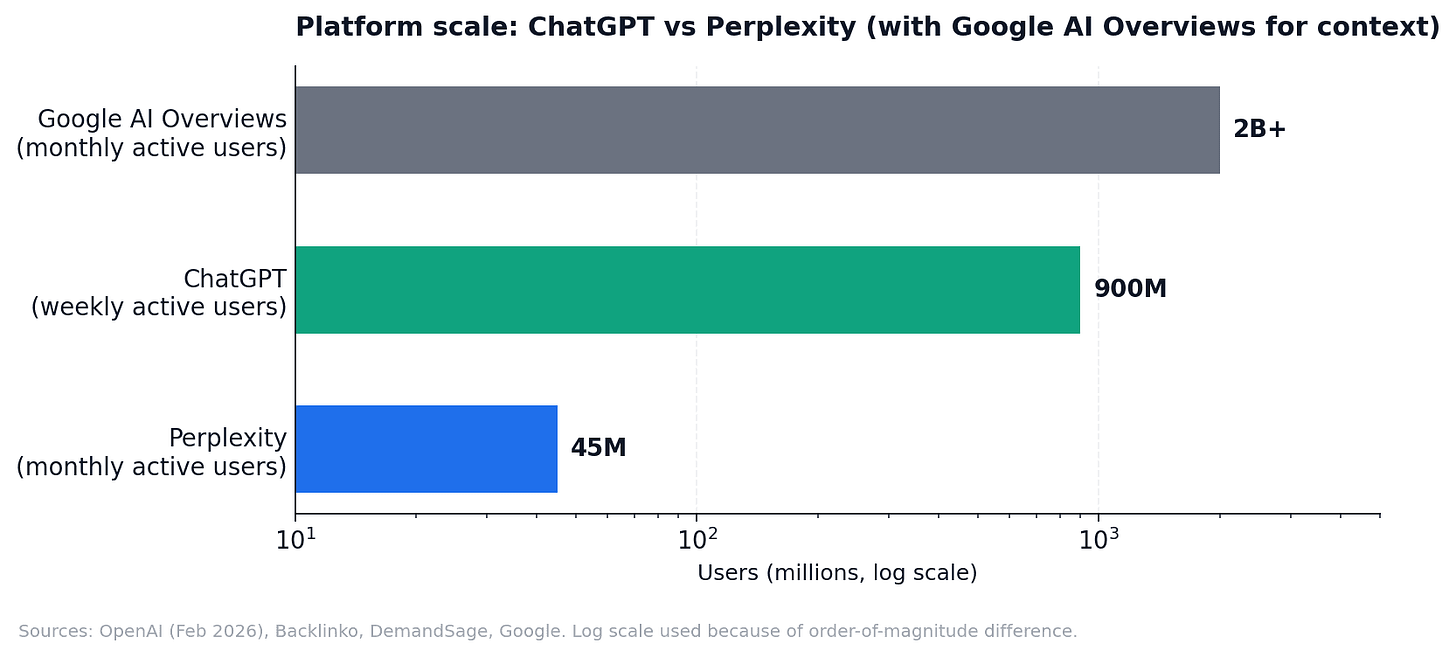
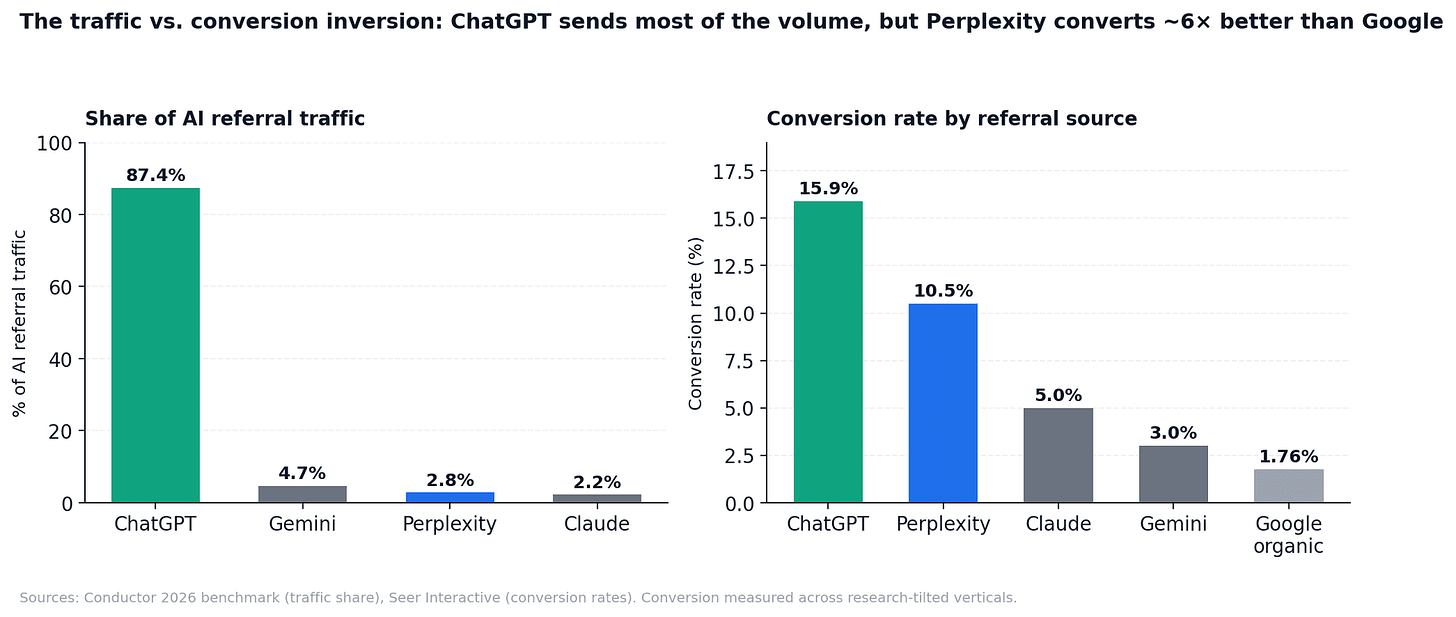
An 11% overlap means there is no single AI-visibility strategy; there are as many as there are engines. A brand that wins in ChatGPT by being encyclopedic and well-cited can be invisible in Perplexity, which rewards authentic community presence, and the 70% churn means a one-time audit is worthless. This is precisely the gap Google's own Search Console AI reports leave open (last week): a first-party console only shows you Google's surfaces. Measuring share of voice, citations, and sentiment across every answer engine, continuously, is the entire premise of what Rankly does.
Amazon v. Perplexity reaches Ninth Circuit oral arguments
The case that hangs over the whole agentic-commerce stack reached Ninth Circuit oral arguments this week, on whether Perplexity's Comet shopping agent may access logged-in Amazon pages on a user's behalf. It is the first major US appellate test of agent-as-visitor rights under the Computer Fraud and Abuse Act. A March preliminary injunction had blocked Comet, the appeals court paused that block days later, and Perplexity has argued Amazon's CFAA theory is a fundamental misfit for an agent acting under explicit user authorization.
Every launch in this brief assumes an agent is allowed to act for its user; this case decides what happens when the site says no. If the court treats an authenticated user's agent as the user, the Visa-OpenAI and Mastercard futures ship unobstructed and Perplexity's newly funded Comet browser keeps its access. If it treats the agent as unauthorized access, platforms gain a CFAA lever to wall off third-party agents and force them through sanctioned surfaces like a merchant's own WebMCP tools or a network's verified directory. The week the card networks built the rails, the courts started deciding who is allowed to drive on them.