TL;DR
- ·WebMCP graduates to a public origin trial in Chrome 149. The browser API that lets a page expose JavaScript functions and HTML forms as schema-described tools moves from behind-a-flag prototype to anyone-can-ship. E-commerce is the fastest-adopting category; an agent completes a WebMCP checkout roughly 3x faster than a scraped one. Edge already supports it, Firefox committed Q3, Safari expected Q4.
- ·Worldline, ING, and Mastercard complete the first live, in-production agentic payment across the Mastercard network in Europe. An ING cardholder paid a Netherlands merchant via an AI agent, with the same rails live in Belgium, authenticated with passkeys plus Mastercard Verifiable Intent. Mastercard Agent Pay crosses from pilot to production at the network level.
- ·Hey Savi and PayPal launch the UK's first agentic commerce platform with native in-app checkout on PayPal Agentic Commerce Services. Shoppers search 10,000+ brands by photo, screenshot, or text and buy without leaving the app. Debenhams Group (Debenhams, Karen Millen, Boohoo, PrettyLittleThing) is the launch retailer.
- ·ChatGPT ads go live in the UK, OpenAI's first market outside North America and ANZ, and its first European-regulated one. Ads hit only the Free and Go tiers, the EU launch requires explicit opt-in consent, and Japan, South Korea, Brazil, and Mexico are next. The AI answer is now a paid-placement surface.
- ·Google ships Generative AI performance reports in Search Console. The first native view of how pages surface inside AI Overviews and AI Mode, broken out by impressions, pages, countries, and devices, and separated from traditional organic. AI-search visibility is now independently measurable. The catch: no click data.
- ·Cloudflare data shows bot traffic crosses the majority threshold at 57.5% of all HTTP requests worldwide, vs 42.5% human, the first time automated systems have outnumbered people. Matthew Prince had predicted this crossover wouldn't arrive until 2027; agentic AI assistants are the accelerant.
- ·Travala launches Travel MCP with gasless USDC settlement on Base via x402. Agents search, reserve, and pay for hotels across 2.2M listings with no human step until final authorization, at roughly $0.01 per booking, with ERC-7715 session keys keeping the final signature in the user's wallet. A concrete production case for MCP plus stablecoin rails.
- ·Microsoft unveils seven in-house MAI models at Build 2026, led by MAI-Code-1-Flash and MAI-Thinking-1 (35B-active MoE, 256K context), plus on-device Aion models. The goal: cut OpenAI dependence and lower inference cost for the agent and tool-use workloads that power Copilot's browse-and-buy flows.
- ·Burson and Profound publish The Credibility Paradox across 55,000+ AI answers about 85 companies on 7 answer engines. Headline: visibility is not credibility. Fact-based claims outperform subjective ones, and decision-makers rate AI answers about 10% more believable than the general public does.
- ·Nectar Social raises a $30M Series A and rebrands to Nectar Agent. Menlo Ventures (Anthology Fund) leads, with True Ventures, GV, and Kinship Ventures. The platform runs autonomous agents for social intelligence and conversational commerce, claiming 10M+ weekly conversations and $100M in attributed revenue for clients like e.l.f. Beauty and Liquid Death.
- ·Amazon v. Perplexity reaches Ninth Circuit oral arguments on whether the Comet shopping agent can access logged-in Amazon pages. The first major US legal test of agent-as-visitor rights under the CFAA, and the case that will set precedent for whether AI agents can transact on sites that have not authorized them.
WebMCP graduates to a public origin trial in Chrome 149
Chrome 149 opened a public origin trial for WebMCP on June 2, moving the Web Model Context Protocol from a behind-a-flag prototype that needed the Early Preview Program to something any site can enable in production. WebMCP lets a page register JavaScript functions and HTML forms as structured, schema-described tools that an in-browser agent invokes directly, instead of scraping the DOM. The spec is co-authored with Microsoft (Edge 147 already shipped support) and incubated in the W3C Web Machine Learning community group. PPC Land reports e-commerce as the fastest-adopting category, where an agent completes a WebMCP checkout roughly 3x faster than a scraped flow. Firefox committed to Q3, Safari is expected in Q4.
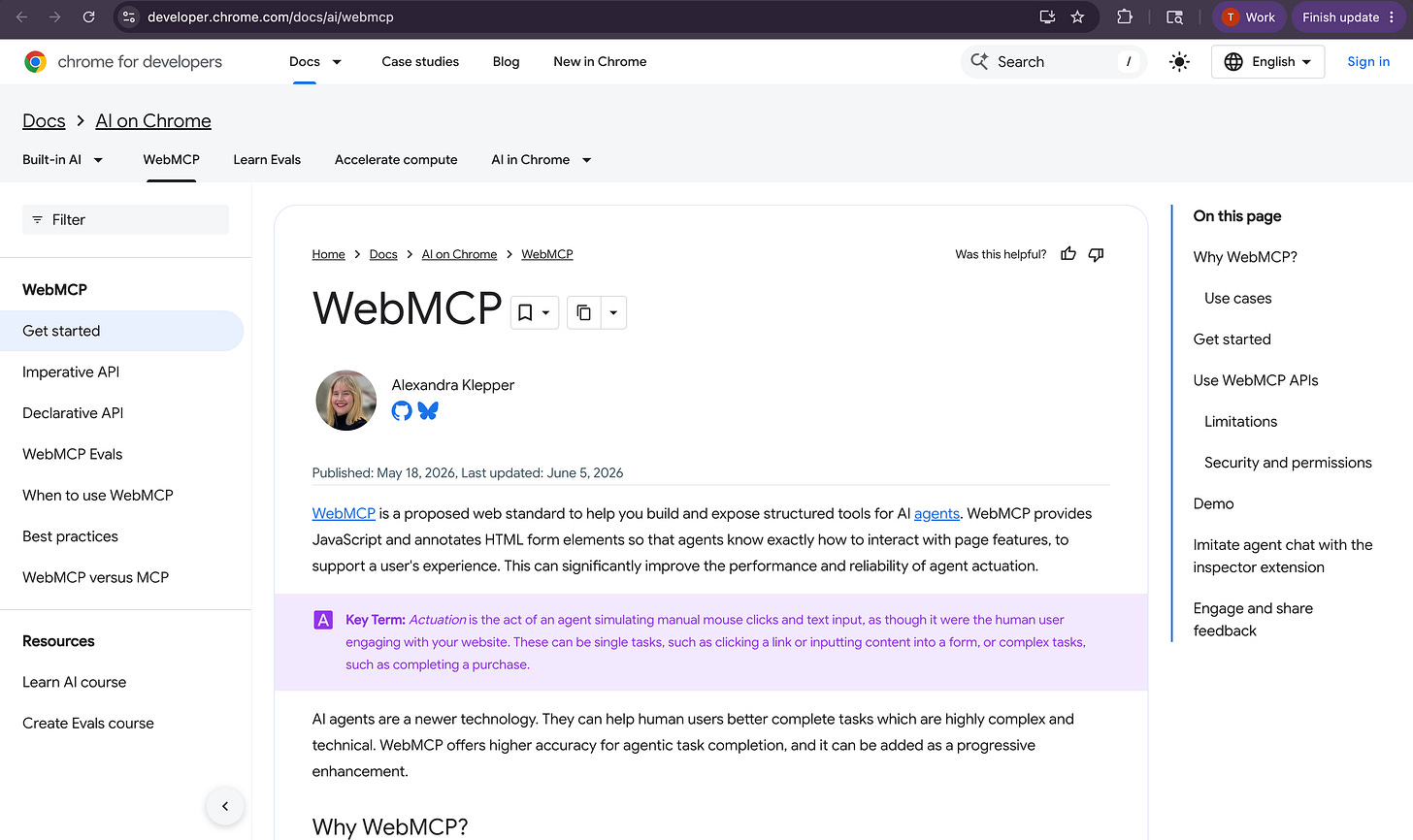
This is the single most important enabler of the week for buyer-side agents, and the reason we wrote a full deep dive on WebMCP. Behind the Early Preview Program, WebMCP was a demo. As a public origin trial it becomes a deployment decision: any merchant can expose a search, add_to_cart, and checkout toolset that Gemini in Chrome or an Inspector-style agent can call without guessing at your markup. The strategic read for merchants is that the agent surface is no longer something done to your site by a crawler; it is something you author and govern per tool.
Worldline, ING, and Mastercard complete the first live agentic payment in Europe
Worldline, ING, and Mastercard completed the first live, in-production agentic payment across the Mastercard network in Europe on June 2. An ING cardholder paid a Netherlands merchant through an AI agent, with the same infrastructure running in Belgium. Authentication used passkeys plus Mastercard's Verifiable Intent, so the action traces back to explicit consumer authorization rather than an agent acting on its own. Payments Dive framed it as Mastercard moving its agentic tooling toward general merchant availability.
The word that matters is production. Mastercard Agent Pay had been a pilot story since the Lisbon rollout (Weekly #12); this is the first settled transaction on live rails with European issuers enabled at the network level. Read it alongside Highnote's first commercial deployment on Visa Intelligent Commerce Connect (Weekly #14) and the agent-payments substrate is now a two-network race where both Visa and Mastercard have crossed from press release to paying transaction inside three weeks of each other.
Hey Savi and PayPal launch the UK's first agentic commerce platform with in-app checkout
AI fashion-search app Hey Savi launched native in-app checkout powered by PayPal Agentic Commerce Services on June 2. Shoppers search across 10,000+ brands by photo, screenshot, or text and complete the purchase without leaving the app. Debenhams Group, covering Debenhams, Karen Millen, Boohoo, and PrettyLittleThing, is the first retailer live. FashionNetwork has the retailer-side detail.
This is PayPal's clearest buyer-side beachhead in Europe and a template for the non-hyperscaler path into agentic commerce: an independent agent surfaces product data across thousands of merchants, then PayPal closes the loop with native checkout. Where the US race is being run by Google Universal Cart and OpenAI's ChatGPT Shopping, the UK's first agent checkout instead routes through a vertical fashion app plus a PSP. Expect more of these app-plus-PSP pairings to ship in markets where the hyperscaler commerce surfaces have not yet localized.
ChatGPT ads go live in the UK, the first market outside North America and ANZ
OpenAI's VP of Monetization Benji Shomair announced on June 6 that the ChatGPT ads pilot went live in the UK, the first time ChatGPT has served ads outside the US, Canada, Australia, and New Zealand, and its first European-regulated market. Ads reach only the Free and Go tiers; Plus, Pro, Business, Enterprise, and Education stay ad-free. Per PPC Land, the UK launch activated an updated EU ads policy added June 2 that requires explicit opt-in consent rather than legitimate interest. Digiday notes Japan, South Korea, Brazil, and Mexico are flagged for the coming weeks; the self-serve Ads Manager is not yet open, so advertisers register interest.
This is the AI answer becoming a paid-placement surface, and it lands the same week Google and Burson made organic AI visibility measurable (below). The two threads are the same story: brands now have an earned position inside AI answers and, increasingly, a bought one right next to it, exactly the dynamic that defined a decade of web search. Gating ads to Free and Go tells you OpenAI is monetizing the non-paying majority while keeping power users clean. The agentic-commerce question this opens: once paid placement enters the recommendation layer that buyer-side agents read, the disclosure line between sponsored and organic results inside an agent's answer becomes the next fight. Merchants should assume the AI surface is now both an SEO problem and a media-buying one.
Google ships Generative AI performance reports in Search Console
Google rolled out dedicated Generative AI performance reports inside Search Console the week of June 3, giving site owners their first native view of how pages surface inside AI Overviews and AI Mode, broken out by impressions, pages, countries, devices, and dates across Search and Discover. For the first time the data separates AI-search visibility from traditional organic, which makes generative engine optimization independently measurable. The rollout notes flag the load-bearing limitation: no click data, so an AI Overview impression does not confirm a clickthrough, and it reached a limited subset of sites first.
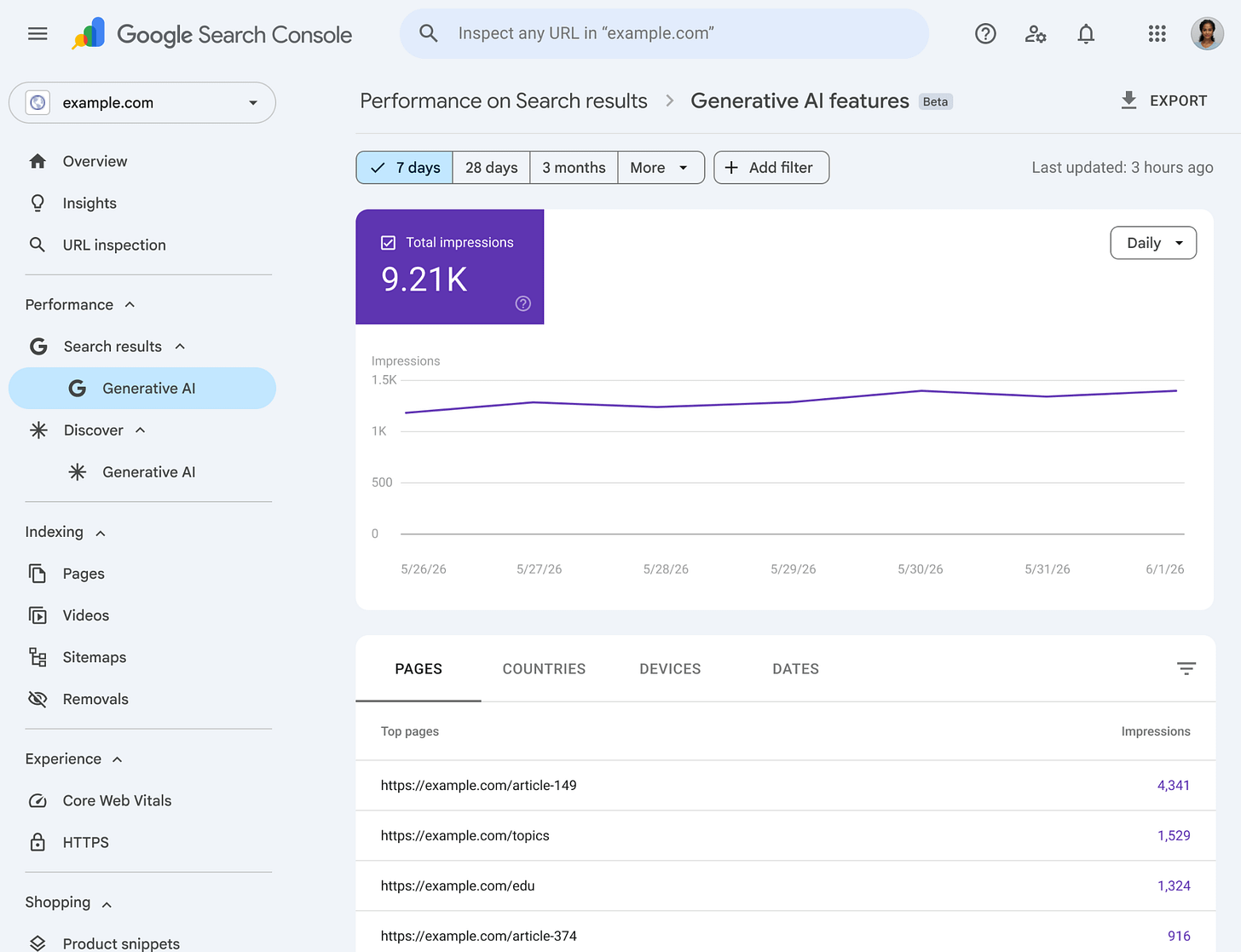
This is Google validating the entire measure-your-AI-visibility category from inside its own console, which is both a tailwind and a boundary. The tailwind: AI visibility is now a first-class metric that every SEO team will be asked about. The boundary: Search Console only sees Google's own surfaces, only reports impressions, and shows nothing about ChatGPT, Perplexity, Copilot, or Gemini app answers. Brands that want share-of-voice across every answer engine, with the citation and sentiment detail Search Console omits, still need independent measurement.
Cloudflare: bot traffic crosses the majority threshold at 57.5%
Cloudflare co-founder Matthew Prince disclosed Radar data showing that automated systems now generate 57.5% of all HTTP requests to web content worldwide, against 42.5% from humans, the first time bots have crossed the majority line. Prince had previously predicted the crossover would not happen until 2027. Agentic AI assistants are the named accelerant: a single agent can visit thousands of pages to complete one task. The data lands directly into Cloudflare's AI Crawl Control and pay-per-crawl monetization push.
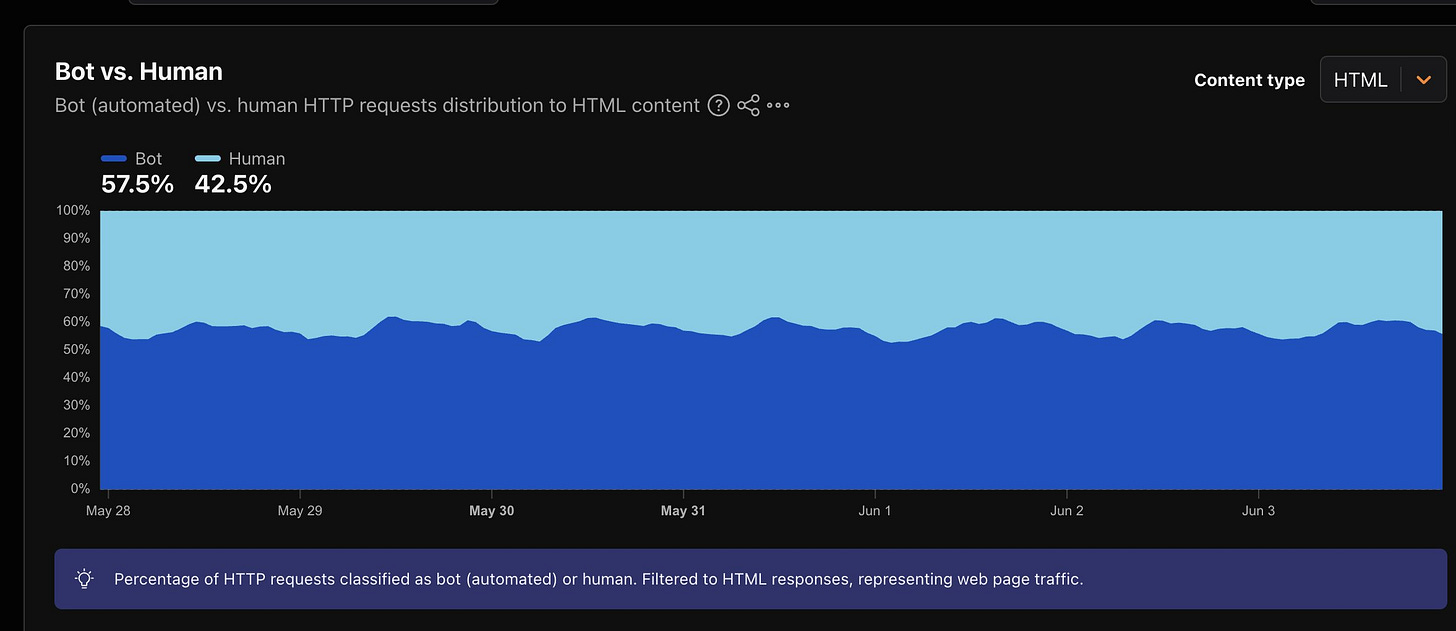
This is the macro backdrop under every story in this brief. Once agents are the majority of your traffic, the question stops being how to block them and becomes how to be legible to the ones you want and gated to the ones you do not. That is a two-sided problem: WebMCP and structured content make you readable to buyer-side agents, while crawl controls and bot management decide who pays for access. Merchants who treat agent traffic purely as a cost to suppress will lose the discovery surface; the move is to author for the agents that convert and meter the ones that only scrape.
Travala launches Travel MCP with gasless USDC settlement on Base via x402
Travala debuted an end-to-end agentic travel protocol on June 4. Autonomous agents search, reserve, and settle hotel payments across 2.2M listings with no human intervention until final authorization, using Coinbase's x402 standard for gasless USDC on Base at roughly $0.01 per booking. The flow runs inside a single Claude chat thread and uses ERC-7715 session keys so the final signature stays in the user's wallet. crypto.news notes flights are next, via Trivago and Skyscanner.
This is a clean production example of the MCP-plus-x402 stack the protocol war keeps pointing at. Coinbase x402 went live on Arbitrum (Weekly #12), Fireblocks joined the x402 Foundation (Weekly #13), and Coinbase shipped Base MCP for Claude, ChatGPT, and Cursor (Weekly #14). Travala is the first vertical to wire all of it into a single booking flow with real inventory. The session-key design is the detail to copy: full autonomy on search and hold, human signature only at settlement, which is the trust boundary consumers actually want.
Microsoft unveils seven in-house MAI models at Build 2026
At Build 2026 in San Francisco on June 2, Microsoft announced seven proprietary MAI models spanning reasoning, coding, image, voice, and transcription, led by MAI-Code-1-Flash for code-from-description and MAI-Thinking-1, a 35B-active mixture-of-experts reasoning model with a 256K context window, plus a family of on-device Aion models. CNBC framed the move as Microsoft reducing its OpenAI dependence and lowering inference cost.
The agentic-commerce read is about unit economics, not benchmarks. Copilot's shopping and browse-and-buy flows are agent and tool-use workloads, the most token-hungry thing a model does, and cheaper first-party inference is what makes always-on buyer-side agents affordable to run at consumer scale. The same week Microsoft co-shipped the WebMCP origin trial in Edge, it gave itself the model stack to drive those agents without paying frontier-API rates for every checkout. Watch whether Copilot's commerce surfaces migrate onto MAI models over the next two quarters.
Burson and Profound publish The Credibility Paradox
Burson, with AI-visibility platform Profound, released The Credibility Paradox on June 2, analyzing 55,000+ AI-generated responses about 85 companies across 7 major answer engines. The headline finding: visibility is not credibility, and showing up in AI answers does not mean being believed. Business decision-makers rated AI answers roughly 10% more believable than the general public did, and fact-based claims about innovation, products, and workplace outperformed subjective ones about leadership and governance. Marketing-Interactive has the breakdown.
Pair this with Google's Search Console AI reports above and the week handed the AEO category both its measurement layer and its next hard problem. Measuring whether you appear in AI answers is now table stakes; the open question is whether the answer is believed and acted on. Burson's prescription, an evidence ecosystem of fact-based, verifiable claims, is the same logic that makes structured content and citable sources matter more than keyword density. Being in the answer is necessary, being the trusted source in the answer is the moat.
Amazon v. Perplexity reaches Ninth Circuit oral arguments
The agent-as-visitor fight came to a head this week as Amazon v. Perplexity headed toward Ninth Circuit oral arguments on whether Perplexity's Comet shopping agent may access logged-in Amazon pages. It is the first major US legal test of agent-as-visitor rights under the Computer Fraud and Abuse Act. A March 10 preliminary injunction blocked Comet, the appeals court paused that block days later, and Perplexity's May 8 brief called Amazon's CFAA theory a fundamental misfit. PYMNTS tracks the procedural posture.
Every other story in this brief assumes agents are allowed to act on a user's behalf; this case decides whether that assumption holds when the site says no. If the Ninth Circuit treats an authenticated user's agent as the user, the WebMCP-and-card-rail future ships unobstructed. If it treats the agent as unauthorized access, then platforms gain a CFAA lever to wall off third-party agents and force them through sanctioned surfaces like Universal Cart or a merchant's own WebMCP tools. The same week that bots became the majority of web traffic, the courts started deciding which of them have a right to be there.