TL;DR
- ·AWS productized Alexa for Shopping as the AWS Agentic Shopping Assistant and sells it to outside retailers. Kate Spade is the named lead customer running an AI Gift Concierge on Bedrock AgentCore + Anthropic Haiku 4.5. Amazon also disclosed that Alexa for Shopping drove roughly $12B in incremental amazon.com sales last year.
- ·Robinhood shipped Agentic Trading + the first agent-payable Gold credit card from a major retail brand. Users let third-party AI agents make purchases on a virtual Robinhood Gold card with monthly caps and 3% cash back; the brokerage exposes equity trading through a Robinhood MCP server. Stock closed +28%.
- ·Visa took an undisclosed strategic stake in Replit and integrated Visa Intelligent Commerce as a native payment primitive inside the Replit IDE. Agents built on Replit now join Visa's Trusted Agent Protocol registry as Visa-trusted endpoints by default. First time an agent IDE becomes a card-network identity on-ramp.
- ·Highnote shipped the first commercial deployment on Visa Intelligent Commerce Connect (VICC), with programmable AI-payment credentials, tokenized card numbers, and per-session spend rules. Initial use cases are B2B: invoice + AP automation, vendor payments, AI-assisted procurement.
- ·Shopify formalized agentic-commerce distribution in its merchant Terms of Service: merchants are now opted in to agentic surfaces by default and can opt specific ones out per agent or per protocol. The first major ecommerce platform to make agent distribution a default ToS clause.
- ·Stord raised a $250M Series F at a $3B valuation and announced Stord Labs as a physical-intelligence layer for agentic purchasing (inventory + fulfillment context exposed to agents).
- ·Coinbase Base shipped Base MCP so Claude, ChatGPT, and Cursor agents can read on-chain Base data and trigger transactions through a single MCP server.
- ·Claude Opus 4.8 dropped with notable lifts on the web-agent benchmarks that actually map to shopping (cart construction, multi-page checkout, returns). Anthropic positions it as the reasoning model for browser-side agents.
- ·Keyrock published trailing-year on-chain agent stats: 176M agent transactions, $73M settled, 98.6% in USDC. The first credible volume number for the agent-to-agent stablecoin economy.
- ·Forrester called a 2026 agentic-commerce hype reset, separating the parts already in production from the parts that are still vendor decks. The first major analyst report to do this for the category.
AWS productizes Alexa for Shopping and sells it to outside retailers
AWS launched the AWS Agentic Shopping Assistant on May 27, productizing the LLM architecture, starter code, and operational learnings from Alexa for Shopping (formerly Rufus) and selling it to any retailer to deploy on its own storefront in roughly 60 days. Kate Spade is the named lead customer, having shipped an AI Gift Concierge on Amazon Bedrock AgentCore plus Anthropic Haiku 4.5 in April. CNBC picked up the disclosure that Alexa for Shopping drove roughly $12B in incremental amazon.com sales last year, the first hard revenue number Amazon has attached to the product.

Strategically this puts AWS in direct opposition to Google’s Business Agent (January 2026) and Pattern Intelligence for the agent-on-your-storefront wedge. Amazon is now selling the same agent stack to retailers it competes with on amazon.com, the same way it built AWS by selling the infrastructure that runs amazon.com. The Kate Spade story is the proof-of-concept: a sub-90-day deployment with brand-safe pricing-aware retrieval and a Haiku-driven concierge layer. Expect a wave of mid-market retailer announcements as the playbook generalizes.
Robinhood ships Agentic Trading and the first agent-payable credit card from a major retail brand
Robinhood announced Agentic Trading + an agent-payable credit card on May 27. Users instruct third-party AI agents to make purchases on a dedicated virtual Robinhood Gold card with monthly caps, per-transaction alerts, and 3% cash back. The same release adds Agentic Trading: agents connect to dedicated brokerage accounts via a Robinhood MCP server and execute equity orders within user-defined guardrails. The stock closed up roughly 28% on the news.
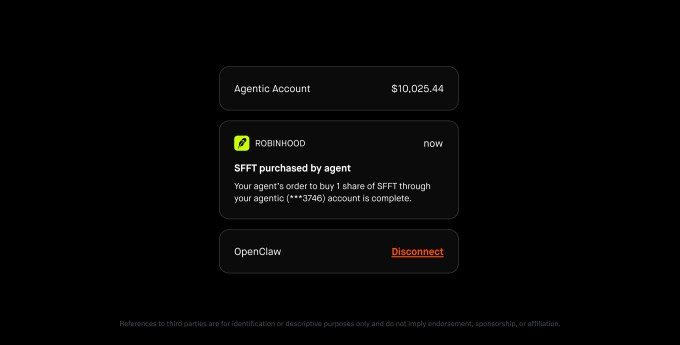
Two firsts in one release. First major retail brand to ship an agent-payable virtual card with native cash-back economics, and first regulated US broker to expose stock trading via an MCP server that any Claude, ChatGPT, or Cursor user can wire up. The card collapses the consumer-finance line that Catena Labs and Stripe Link have been pushing toward. The MCP server collapses the brokerage-API onboarding step that existing API-first brokerages still treat as a developer-only motion. Watch which retailers wire up acceptance of the Robinhood Gold agent card next, because the merchant side of the loop is now real consumer credit, not crypto-only x402 settlement.
Visa invests in Replit and turns the IDE into a Trusted Agent Protocol on-ramp
Visa took an undisclosed strategic stake in Replit on May 28 and is integrating Visa Intelligent Commerce as a native payment primitive inside the Replit IDE. Agents built on Replit can now join Visa’s Trusted Agent Protocol registry as Visa-trusted endpoints by default. TechCrunch’s read framed it as Visa monetizing the vibe-coding long tail; The New Stack covered the developer-side impact. Replit also launched a Solution Partner Program the same day.
This is the first time an agent IDE platform (not a retailer, not a PSP) becomes the default on-ramp into a card network’s agent-identity registry. The strategic read: Visa is racing Mastercard Agent Pay and Google AP2 to claim the agent-trust layer, and Replit is a wedge into the tens of thousands of hobbyist + indie agents that would otherwise have no path onto card rails. Pair with Highnote on Visa Intelligent Commerce Connect (below) and Visa now has both ends of the agent-payments pipe locked: developer on-ramp at Replit, B2B production at Highnote.
Highnote ships the first commercial deployment on Visa Intelligent Commerce Connect
Issuer-processor Highnote launched Agentic Commerce capabilities on May 27, built on Visa Intelligent Commerce Connect (VICC), the agnostic agent on-ramp Visa announced in April. The product ships programmable AI-payment credentials with tokenized card numbers, real-time authorization logic, and per-session spend rules. Initial use cases are B2B: invoice and accounts-payable automation, vendor payments, operational spend, and AI-assisted procurement. Finovate framed it as the first commercial agent-payments product running on the new VICC rails.
Strategically this is the moment Visa Intelligent Commerce Connect stops being a press-release primitive and becomes a paying product line. It validates the April pilot cohort (Aldar, AWS, Mesh, Payabli, Sumvin) and pushes agentic payments out of consumer-shopping demos into the harder B2B procurement workflows where the volume actually is. Read alongside the Mastercard Agent Pay Lisbon rollout (Weekly #12) and AP2’s donation to the FIDO Alliance (Weekly #13), and the agent-payments substrate is now a three-network race with Visa first to a paying production deployment.
Shopify formalizes agentic-commerce distribution in merchant ToS
Shopify published an upcoming terms update on May 25 governing how merchants are surfaced to agentic distribution channels (ChatGPT Shopping, Gemini, Microsoft Copilot, OpenAI Operator, the UCP merchant graph). Merchants get explicit opt-in / opt-out per channel plus a revenue-share posture on agent-mediated orders. Quiet legal update, large strategic implication.
This is the first major commerce platform to write the agent-distribution contract directly into its merchant ToS, ahead of an explicit opt-in flow. Read alongside Pattern Group’s GEO + Alexa for Shopping Scorecard (Weekly #13) and Google’s Universal Cart launch partner roster, the platform layer is now formalizing the agent surface as a first-class distribution channel with negotiated economics. Expect BigCommerce, WooCommerce, Salesforce Commerce Cloud, and Adobe Commerce to copy the template inside the next two quarters.
Stord raises $250M Series F at $3B and opens Stord Labs as the physical-intelligence layer for agentic purchasing
Stord raised a $250M Series F at $3B on May 26, led by returning investor Strike Capital, with Kleiner Perkins, Founders Fund, Bond, Lux, Franklin Templeton, Baillie Gifford, and G Squared participating. Same release announced Stord Labs in Atlanta, a new facility for agentic AI + robotics tested against roughly 100 live fulfillment facilities, $15B annual GMV, and 8B data points per year. The explicit pitch: the physical intelligence layer for agentic purchasing. TechCrunch framed it as a direct shot at Amazon’s vertical stack; Bloomberg has the merchant-side breakdown.
Biggest agentic-commerce-adjacent raise of the week, and the cleanest articulation yet that fulfillment is the next moat once agents handle discovery + checkout. The thesis: once buyer-side agents resolve “what to buy” via ACP, UCP, or AP2, the sustained margin advantage shifts to whoever can get the unit picked, packed, and shipped in under 24 hours at a sub-Amazon cost basis. Stord is betting that’s a brand-owned multi-tenant facility, not the Amazon FBA monoculture.
Coinbase Base ships Base MCP for Claude, ChatGPT, and Cursor
Coinbase’s L2 Base launched Base MCP on May 26, an MCP server that lets AI agents from Claude, Cursor, and ChatGPT execute token transfers, swaps, and DeFi interactions via natural language. Every transaction triggers an in-flow Base Account review window for confirm or reject. Launch plugin partners include Moonwell, Morpho, Uniswap, Avantis, Bankr, Aerodrome, and Virtuals. CoinDesk read it as the missing client-side glue for the x402 + AgentCore Payments + Stripe MPP stack Coinbase has been quietly assembling.
Base MCP sits at exactly the layer the protocol war keeps trying to occupy. ACP and UCP both terminate at a card-network rail. AP2 (FIDO-stewarded) sits one layer below. Base MCP is the only path today that lets a generalist LLM transact on stablecoin rails without a custom integration per agent. Coinbase x402 went live on Arbitrum (Weekly #12) and Fireblocks joined the x402 Foundation (Weekly #13); Base MCP is the consumer-side counterpart. Three weeks of x402 momentum in a row.
Claude Opus 4.8 lifts the web-agent benchmark that actually maps to shopping
Anthropic shipped Claude Opus 4.8 on May 28. The headline numbers: agentic coding moves from 64.3 to 69.2, and Online-Mind2Web (the standard web-agent benchmark covering navigation, form-fill, and end-to-end checkout flows) lands at 84%, above Opus 4.7 and GPT-5.5. Same price as 4.7. Fast mode now 3x cheaper. Live in API, Bedrock, Vertex, and GitHub Copilot day one. Also adds “dynamic workflows” inside Claude Code for very-large tasks.
Online-Mind2Web is the single benchmark merchant teams should track. It includes shopping + checkout tasks, multi-step navigation across unfamiliar sites, and form interactions that approximate what a Buy for Me or Universal Cart agent has to handle in production. An 84% top-line on a frontier model that’s available across every major agent platform on day one means the buyer-side agent stack just got materially more reliable for the same dollar. Same week as Forrester’s sober reset, the capability layer underneath the hype keeps quietly improving.
Keyrock: 176M on-chain agent transactions and $73M settled in the trailing year, 98.6% USDC
Market maker Keyrock’s Who Pays the Agent? report hit the secondary news cycle the week of May 25. The headline numbers across the trailing May 2025 to April 2026 window: 176M on-chain agent transactions, $73M settled, and 98.6% of the volume in USDC. CoinDesk’s coverage and the FinanceFeeds breakdown are the cleanest secondary reads.
Two readings of the data. Either $73M is a tiny number, in which case agentic stablecoin payments are still a research demo, or 176M transactions is a huge number that says the average ticket size is tiny (sub-$1 microtransactions) and the volume is dominated by content unlock and API metering, not e-commerce. Both are true. The USDC concentration is the more durable signal: AP2-era agent payments will need a stablecoin path even if card networks ship their own rails, and USDC is what the deployed infrastructure is already using.
Forrester: agentic commerce hype reset for mid-2026
Principal Analyst Emily Pfeiffer published a sober mid-year readout on May 28. Most agentic experiences in 2026 are still conversational discovery, not autonomous purchase. True autonomy remains rare. Consumer trust is low across demographics. Forrester’s prescription for merchants: invest in owned-channel experimentation, content for AI systems, and breaking internal silos before betting on any third-party agent platform.
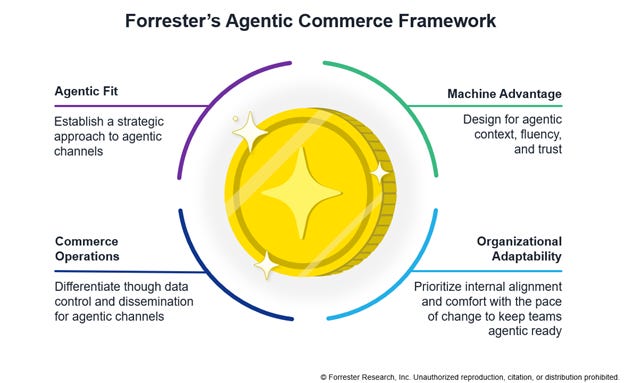
This is the first major analyst-firm reset of expectations since the I/O 2026 hype wave (Universal Cart, AP2 to FIDO, Gemini Spark). Useful counterweight for merchant teams being pushed by a vendor to overbuild for a protocol no one is fully shipping on yet. Read alongside Sopra Steria’s European study from Weekly #11 (41% of European consumers don’t trust any AI shopping agent provider), the consumer-trust gap is the load-bearing constraint on the next twelve months of the agentic-commerce thesis.