11 Jan 2026
Launched at NRF
10
Tech Council Members
40+
Endorsing Partners
Amazon, Meta, Microsoft, Salesforce, and Stripe joined the UCP Tech Council on 24 April 2026, doubling it to ten companies. The protocol itself is three months old. Sundar Pichai unveiled UCP at NRF on 11 January with six co-developers, 40+ endorsers, and a live GitHub by end of keynote. The spec is now on v2026-04-08. Copilot and Gemini are wiring it into checkout. This post covers what UCP is, who built it, how it relates to A2A, AP2, MCP, and ACP, and what the architecture actually looks like.
What is UCP
Think of the web in 1991. Tim Berners-Lee did not need to call up every server operator and negotiate a custom integration. He defined HTTP, a tiny set of verbs and headers, and any browser could talk to any server that spoke the same protocol. That single act of standardization is what made the open web possible.
Agentic commerce in 2025 had no such thing. Every AI surface needed a custom connector for every merchant, and every merchant needed a custom connector for every AI surface. Google calls this the "N times N integration bottleneck."
UCP is the fix. Per ucp.dev:
"The common language for platforms, agents and businesses."
Concretely: a small set of building blocks (discovery, catalog, cart, checkout, identity linking, payment token exchange, post-purchase) that any merchant publishes once and any agent can consume. Same shape as HTTP for the web.
UCP is not a marketplace, not a payments network, not a search engine, not a trust guarantee. It is a contract: how two systems introduce themselves, what data shapes to expect, how to negotiate features. Whether the resulting transaction is good for either party is a separate question, addressed in the closing section.
Official Resources
Everything is open source under Apache 2.0. The canonical sources, with no marketing layer:
Canonical Sources
At the time of writing, the main spec repo has roughly 2,800 stars and 350 forks, with 40 open issues and 45 open pull requests. That is active for a four-month-old project, though it is worth noting that most contributions still come from Google, Shopify, and the Tech Council member companies. The current published version is v2026-04-08, which uses date-based versioning rather than semver. Two earlier releases shipped on v2026-01-11 (initial public drop) and v2026-01-23 (a maintenance refresh).
Who Developed It
UCP was developed privately and revealed cold at NRF 2026 on 11 January. There was no public RFC process before launch, no working group draft circulated, no v0.1 community preview. Sundar Pichai introduced it during his keynote, Google's blog post by Vidhya Srinivasan went live the same day, and Shopify engineering lead Ilya Grigorik published a parallel deep dive on shopify.engineering. Within hours, partner press releases from PayPal, Salesforce, and Commerce.com appeared in tandem. The launch was choreographed.
Six Co-Developers (announced 11 Jan 2026)





Governance sits with the UCP Tech Council, described in the official 24 April 2026 press release as the body that "aligns UCP's technical direction, reviewing contribution proposals and stewarding the open-source protocol." The actual roster lives in MAINTAINERS.md; the deliberation record is the public TC meeting minutes. The council started with five members at launch and doubled in size three months later when Amazon, Meta, Microsoft, Salesforce, and Stripe joined, with the MAINTAINERS update landing the same day. The specific contribution PRs reviewed across the March and April TC syncs are #257, #340, #354, #367, and #375.
Founding members, 11 Jan 2026
Google, Shopify, Etsy, Target, Wayfair
Added 24 Apr 2026
Amazon, Meta, Microsoft, Salesforce, Stripe
Two things worth noticing about that list. First, Apple is conspicuously absent, which mirrors its absence from MCP, A2A, and most agent infrastructure standards. Second, Stripe sits on the UCP Tech Council despite having co-authored the competing Agentic Commerce Protocol (ACP) with OpenAI four months earlier. Stripe is now the bridge between both stacks, which we will return to in the UCP versus ACP section.
The named individuals shaping UCP, in case you want to follow them:
- Vidhya Srinivasan, VP and GM of Ads & Commerce at Google. Primary public spokesperson.
- Ashish Gupta, VP and GM of Merchant Shopping at Google. Co-author of the technical "under the hood" post.
- Nick Fox, SVP of Knowledge & Information at Google. Welcomed the Tech Council expansion.
- Vanessa Lee, VP Product at Shopify. Primary Shopify spokesperson.
- Ilya Grigorik, Distinguished Engineer at Shopify. Lead author of the engineering deep dive.
- Mani Fazeli, VP Product at Shopify. Co-builder of the spec.
Partners
Three distinct partner buckets, often flattened in press coverage. Lists below pulled directly from ucp.dev, the Google launch post, and the Shopify launch post.
Endorsing partners on ucp.dev (29): in payments, Adyen, Affirm, Amex, Ant International, Block, Checkout.com, Fiserv, Klarna, Mastercard, PayPal, Splitit, Stripe, Visa, Worldpay. In retail, Best Buy, Carrefour, Chewy, Flipkart, Gap, The Home Depot, Kroger, Lowe's, Macy's, Sephora, Shopee, Ulta, Zalando. On the platform side, Commerce (Feedonomics) and Salesforce.
Live on Google AI surfaces at launch: Business Agent retailers Lowe's, Michael's, Poshmark, Reebok; Direct Offers pilot brands Petco, e.l.f. Cosmetics, Samsonite, Rugs USA.
Shopify-merchant launch brands: Monos, Gymshark, Everlane, Keen, Pura Vida.
Amazon, Meta, Microsoft, Salesforce, and Stripe are Tech Council members as of 24 April 2026 (covered above), not endorsers per ucp.dev. Microsoft is a launch implementer via Copilot Checkout. Stripe and Salesforce appear in both lists.
Day-one positioning from the principals: John Furner (Walmart U.S. CEO) framed UCP as infrastructure, not a feature. Pablo Fourez (Mastercard CDO) on payments at scale. Nayna Sheth (Microsoft) on Copilot Checkout consuming UCP. PayPal's Michelle Gill and Prakhar Mehrotra committed PayPal as a launch payment option.
Who It's For
Four audiences, four different reasons to read the spec.
Businesses (merchants)
If you sell things, UCP gives you a way to be discoverable and transactable by every AI agent without writing one connector per agent. Implement a UCP server (or use a proxy like Shopify's), publish a /.well-known/ucp manifest, and you appear in Gemini, ChatGPT, Copilot, Claude, and any future agent that speaks UCP.
Platforms (AI surfaces)
If you are building a consumer-facing AI product (Gemini, Copilot, ChatGPT, Perplexity, Shop), UCP lets you transact with the long tail of merchants without a thousand bilateral integrations. Implement a UCP client, advertise your platform via a UCP-Agent header, and you can read every UCP-compliant catalog and run checkouts on every UCP-compliant merchant.
Agents (the autonomous layer)
If you are building an agent framework (LangChain, ADK, Inkeep, Upsonic), UCP gives your agents commerce-aware tools out of the box. UCP capabilities can be exposed as MCP tools or A2A skills, so an agent can search a catalog or fill a cart without custom adapters.
Payment providers
If you are a PSP, card network, BNPL provider, or wallet, UCP's Payment Token Exchange capability slots you into the flow. You become the credential provider that businesses delegate to, without having to wedge yourself into proprietary checkout experiences. PayPal, Stripe, Adyen, Klarna, Visa, Mastercard, and Amex all signed on for this reason.
UCP vs A2A, AP2, MCP
A2A, AP2, and MCP are not part of UCP. They are independent protocols UCP composes with. UCP sits one layer above and is deliberately transport-agnostic and payment-agnostic.
Here is what each protocol actually does, why it exists, and how UCP relates to it.
MCP (Model Context Protocol)
Anthropic-originated, now widely adopted. Defines how an LLM agent invokes external tools (function call shape, JSON-RPC framing). UCP capabilities can be exposed as MCP tools, so an agent that already speaks MCP calls checkout.create or catalog.search without learning a new protocol. One of UCP's transport bindings.
A2A (Agent2Agent)
Google's agent-to-agent messaging protocol. Where MCP is one agent calling tools, A2A is two autonomous agents negotiating directly (Agent Cards, skill descriptions, handoffs). UCP can be exposed via A2A for buyer-side agents talking to merchant-side concierge agents. Another transport binding alongside MCP and REST.
AP2 (Agent Payments Protocol)
Google's protocol for agent-mediated payment authorization. AP2 defines how an agent obtains a payment token from a credential provider (PayPal, Visa, Stripe) with cryptographic proof of consent, and how the token reaches the merchant for finalization. UCP's Payment Token Exchange capability speaks AP2 under the hood; AP2 is the substrate, UCP is the wrapper.
REST (and JSON-RPC)
The default UCP transport. Merchants expose capabilities as plain HTTP endpoints (/checkout-sessions, /catalog). Lowest-friction transport; required baseline for any UCP server.
ECP (Embedded Checkout Protocol)
Shopify-led, distilled from Shopify's Checkout Kit into an open layer. Renders the merchant's real checkout inside the agent's surface and carries bidirectional state (merchant pushes status updates, agent pushes credentials and context). The fourth official transport; ucp.dev calls it "EP (Embedded Protocol)." This is the protocol that handles the unavoidable human-in-the-loop moments (3DS, age gate, address confirm) without bouncing the buyer out of the agent UI.
The mental model: UCP is the contract, MCP and A2A are how the contract gets carried, AP2 is how money moves inside the contract. Shopify engineering described the layering as "explicitly inspired by TCP/IP separation of concerns," which is a useful frame. You can change the transport without changing the spec, and you can swap payment providers without rewriting the catalog.
Architecture
Three nested concepts: services, capabilities, extensions. Most of the spec describes how they compose. The official high-level diagram, then a zoom-in on the nesting:
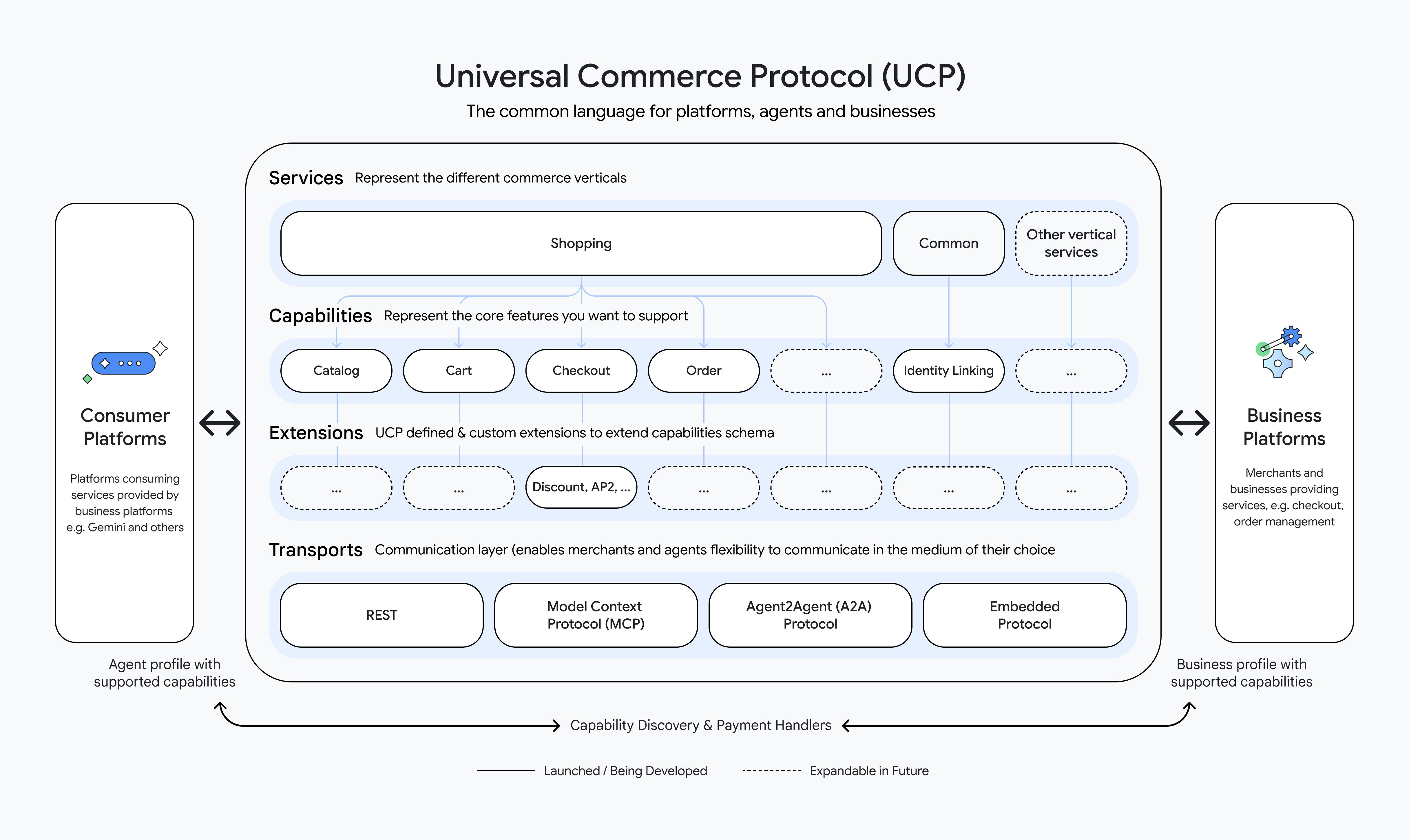
Service
Top-level container. Today there is one: Shopping Service, namespace dev.ucp.shopping. Owns core transaction primitives: checkout sessions, line items, totals, status messages.
Capability
A functional area within a service. Independently versioned and independently negotiated. Current six: checkout, cart, catalog, order, identity-linking, payment-token-exchange. Merchants implement any subset.
Extension
Composable schema add-ons. Extensions modify shared structures via JSON Schema allOf. Discounts modify totals. Fulfillment adds an entry to totals.type. Extensions are pruned during negotiation if their parent capability isn't supported on both sides.
The naming convention is reverse-domain ({reverse-domain}.{service}.{capability}), so an installments add-on you author at example.com would be com.example.payments.installments. The spec then enforces a rule: "The origin of spec and schema URLs MUST match the namespace authority." That single line is what makes UCP governance decentralized. Anyone can publish an extension; nobody needs Google's permission. As long as your namespace matches a domain you control and your schema is fetchable from there, agents and merchants can adopt it.
Discovery Manifest
Same convention as robots.txt, security.txt, and OpenID Connect: every UCP-compliant business publishes a JSON manifest at:
https://{merchant-domain}/.well-known/ucpEvery Shopify store already serves this by default as part of Agentic Storefronts, with no merchant action required. Hit /.well-known/ucp on any Shopify-hosted brand (e.g. monos.com, gymshark.com) to see a live one. Abbreviated, the file looks like:
{
  "ucp_version": "2026-04-08",
  "business": {
    "name": "Example Store",
    "domain": "example.com"
  },
  "services": {
    "dev.ucp.shopping": {
      "capabilities": {
        "checkout":   { "versions": ["2026-04-08"], "endpoint": "/ucp/checkout" },
        "cart":       { "versions": ["2026-04-08"], "endpoint": "/ucp/cart" },
        "catalog":    { "versions": ["2026-04-08"], "endpoint": "/ucp/catalog" },
        "order":      { "versions": ["2026-04-08"], "endpoint": "/ucp/order" },
        "identity-linking": { "versions": ["2026-04-08"] }
      },
      "extensions": [
        "dev.ucp.shopping.discounts",
        "dev.ucp.shopping.fulfillment"
      ]
    }
  },
  "transports": ["rest", "mcp"],
  "payment_handlers": ["paypal", "stripe", "shop_pay"]
}
Reading this from the agent side, the platform also advertises its own profile via a UCP-Agent HTTP header on outbound requests. The capability negotiation algorithm is straightforward: take the intersection of capabilities supported by both sides, take the intersection of versions for each surviving capability, pick the highest version. Extensions whose parent capability did not survive get pruned. Whatever is left is the working contract for this session.
The spec calls this "permissionless onboarding." No central registry, no Google-issued API key gate (yet), no approval queue. Whether it stays that way is the question the outlook section returns to.
Rankly's UCP/ACP validator checks your store's agent readiness and protocol compliance. The playground on the same page shows what an agentic transaction looks like end to end.
The Six Capabilities
Version v2026-04-08 ships with six core capabilities. The first four (Checkout, Cart, Catalog, Order) cover the consumer-side transaction flow. The last two (Identity Linking, Payment Token Exchange) cover the trust and money-movement layer.
Catalog: pull-based product search and lookup. Agents query the merchant's endpoint with structured filters; merchants serve live inventory directly. Opposite of ACP's feed-indexed model.
Cart: basket building before purchase intent firms up. Added in v2026-04-08. Add, modify, price line items without committing to a session, which matters for comparison flows.
Checkout: session lifecycle (create, update, complete, cancel). Tax, totals, and a "human intervention" escape hatch for when a flow needs a real person. Shopify's Embedded Checkout Protocol layers on top.
Order: webhook-driven post-purchase events (shipping, delivery, returns, refunds). The spec defines event shapes, not merchant state machines.
Identity Linking: OAuth 2.0-based delegated authorization. Consumers link an existing merchant account to an agent so it can act on their behalf using saved addresses, payment methods, and loyalty status, without ever seeing raw credentials.
Payment Token Exchange: AP2-backed token flow. Platforms tokenize, businesses redeem. Credentials never leave the credential provider; businesses never echo them back. The mechanism PayPal, Stripe, Visa, and Mastercard plugged into.
Conformance lives in the conformance suite: per-capability test files (checkout_lifecycle_test.py, order_test.py, webhook_test.py) plus cross-cutting tests for idempotency, signing, and AP2 binding.
The Trust Triangle
UCP's payment model, the Trust Triangle, is the most consequential architectural decision in the spec. It defines who holds credentials, who tokenizes, who redeems. The binding rule, verbatim:
"Credentials flow Platform to Business only. Businesses MUST NOT echo credentials back in responses."
Concrete flow: a Gemini agent buys running shoes from Wayfair, paid with the consumer's saved Visa.
- 01Gemini (Platform) requests a tokenization handler from Visa (Credential Provider). The agent never sees the card number.
- 02Visa returns a one-time payment token bound to this transaction, with cryptographic proof of consumer consent (AP2).
- 03Gemini hands the token to Wayfair (Business) inside the UCP checkout session.
- 04Wayfair redeems the token directly with Visa to capture the funds. The token is single use, scoped, and never echoed back to Gemini.
- 05Wayfair completes the order, fires order webhooks back through UCP. Gemini relays status to the consumer.
Two binding details. Since v2026-04-08, every UCP request and response supports RFC 9421 HTTP message signatures, so origin and integrity verify at the HTTP layer, not just the application layer. The spec also defines "Signals": structured environment data (IP, user agent, device fingerprint hints) with reverse-domain provenance, so merchants can tell whether a fraud signal came from Google's agent or a third-party tool.
The result is a payment-rail-agnostic flow. The same machinery handles cards, BNPL (Affirm, Klarna), wallets (PayPal, Shop Pay), and even crypto. MultiversX shipped the first L1 blockchain integration in March, which is a useful proof point that the abstraction holds beyond cards.
Transports
UCP defines four transport bindings. A merchant declares which ones it supports in the manifest, and the agent picks one for the session. All four carry the same logical operations; the difference is framing.
REST (HTTP + JSON): the default. Path-based endpoints, idempotency keys, conventional status codes. Required baseline for any UCP server.
MCP (JSON-RPC): UCP capabilities exposed as MCP tools. An agent calls checkout.create the same way it calls any other MCP tool.
A2A (Agent Cards): two agents negotiating directly. Useful for B2B flows and buyer-side agents talking to merchant-side concierge agents.
ECP (Embedded Checkout Protocol): the protocol for putting a real merchant checkout inside the agent's surface. JSON-RPC 2.0 channel carrying state updates from the merchant, credentials and context from the agent, both directions. Born from Shopify's Checkout Kit, distilled into an open layer that any merchant or platform can speak. ucp.dev refers to it as "EP (Embedded Protocol)"; same thing. This is what powers the "human in the loop" moments (3DS challenge, age verification, address confirmation) without breaking out of the agent's UI.
Most launch-day implementations ship REST plus one of MCP or A2A. Shopify/ucp-proxy: REST + MCP. Google's sample server: REST. NVIDIA's blueprint: all four, because it implements UCP and ACP simultaneously.
Code and SDKs
The official organization at github.com/Universal-Commerce-Protocol hosts eight repositories, all Apache 2.0. The most important six:
ucpThe spec itself plus JSON Schemas plus markdown docs
samplesReference implementations: FastAPI server, Hono + Zod stack, A2A retail agent
python-sdkPydantic models auto-generated from UCP JSON schemas
js-sdkTypeScript types and Zod schemas, published as @ucp-js/sdk on npm
conformanceLanguage-agnostic test suite that runs against any UCP merchant server
ucp-schemaSchema validator and CLI, install with cargo install ucp-schema
Beyond the official org, the most useful integrations to study:
Stateless Go proxy that translates UCP requests to native platform APIs. Per-tenant deploy with pluggable adapters (WooCommerce, Wix, custom). Endpoints: GET /.well-known/ucp, POST /checkout-sessions, PUT /checkout-sessions/{id}, POST /checkout-sessions/{id}/complete. MIT. The canonical "drop-in agent gateway" pattern.
NVIDIA Retail Agentic Commerce blueprint
Most complete end-to-end example. Implements UCP and ACP simultaneously. FastAPI merchant API, PSP service, MCP server with product widgets, NVIDIA Agent Toolkit agents, Next.js storefront. Uses Nemotron-Nano-V3 and NV-EmbedQA-E5-v5. Best read for what a real dual-stack deployment looks like.
Community ports and integrations
Magento 2 module from Magebit, Shopware 6 plugin from Agentic Commerce Lab, community Go SDK, WooCommerce and PrestaShop ports from nuvols-app, and the ecosystem index at Upsonic/awesome-ucp.
Package registry status as of late April 2026: the official JS SDK is live on npm as @ucp-js/sdk, the Rust schema validator is on crates.io as ucp-schema (v1.2.0), the Python SDK is currently install-from-source (git clone plus uv sync), and there is a community Go module at github.com/dhananjay2021/ucp-go-sdk. No official PyPI release yet.
Rankly's UCP/ACP validator checks your store's agent readiness and protocol compliance against both specs. The playground on the same page walks through an agentic transaction end to end.
Timeline
The full chronology, with a few earlier signposts that are useful context.
OpenAI and Stripe launch the competing Agentic Commerce Protocol (ACP) with Instant Checkout in ChatGPT, per Stripe's announcement. Etsy is the first live merchant. This sets the competitive backdrop UCP responds to four months later.
UCP officially announced at NRF 2026 in New York. Sundar Pichai introduces it during his keynote. Six co-developers named. 20+ endorsing partners listed. GitHub release v2026-01-11 ships. Shopify Engineering and Google Developers blog posts go live the same day. PayPal, Salesforce, and Commerce.com drop simultaneous press releases.
GitHub release v2026-01-23, a maintenance refresh.
Google publishes the first feature update: Cart, Catalog, and Identity Linking capabilities. Stripe, Salesforce, and Commerce Inc named as new implementing partners.
Google publishes UCP onboarding guide in Merchant Center, including a sandbox for identity linking and checkout.
GitHub release v2026-04-08, the current version. Adds cart, multi-parent schema support, expanded error model, request and response signing per RFC 9421, embedded checkout enhancements. ~23 contributors credited.
UCP Tech Council expands. Amazon, Meta, Microsoft, Salesforce, and Stripe formally join the existing five (Google, Shopify, Etsy, Target, Wayfair).
No public RFC drafts existed before NRF. UCP was developed privately among the six co-developers and revealed cold. Critics read this as standardization-as-aggregation rather than community-first; it also explains why the contributor list is still mostly Tech Council members.
UCP vs ACP
ACP is the Agentic Commerce Protocol, launched on 29 September 2025 by OpenAI and Stripe to power Instant Checkout in ChatGPT. The two protocols overlap in surface area but differ sharply in scope and philosophy. Several companies (Stripe, PayPal, Etsy, Salesforce) sit on both sides.
UCP vs ACP at a glance
| Axis | UCP | ACP |
|---|---|---|
| Backers | Google, Shopify, Etsy, Target, Walmart, Wayfair | OpenAI, Stripe |
| Launch | 11 Jan 2026 at NRF | 29 Sep 2025 |
| Scope | Discovery, cart, checkout, identity, post-purchase | Checkout-focused |
| Discovery | Decentralized (/.well-known/ucp per merchant) | Centralized (ChatGPT-curated) |
| Catalog | Pull (live merchant API) | Search (pre-indexed feeds) |
| Surfaces | Multi-platform (Gemini, Copilot, ChatGPT, Shop) | Optimized for ChatGPT |
| Payments | AP2 substrate, payment-rail agnostic | Stripe-led tokenization |
| Lead philosophy | Merchant + platform led | Infrastructure led |
Stripe is the hedge: co-authored ACP, then joined the UCP Tech Council four months later. Their pitch: one integration, both protocols. If UCP wins the merchant side and ACP wins the ChatGPT side, Stripe captures the payment leg either way. NVIDIA's blueprint ships dual-stack against a single merchant API. The realistic 2026 posture for a serious merchant: support both.
Underlying split: ACP assumes ChatGPT is the canonical entry point, so the protocol can be checkout-only with platform-side discovery. UCP assumes a multi-surface world where no single agent dominates, so discovery has to be merchant-led. Whether that holds depends on whether OpenAI, Google, Microsoft, and Anthropic stay in equilibrium or one runs away with the consumer.
Outlook
Ben Thompson at Stratechery frames UCP as "Google running its classic playbook": open-protocol generosity (UCP, AP2, A2A, MCP) bundled with proprietary distribution (Gemini, Search AI Mode, Merchant Center). Same move as open Android plus closed GMS, repeated for AI commerce. The protocol is genuinely open. The aggregation layer that benefits from it is not.
Antitrust economist Ted Tatos at The Sling argues UCP imports Google's "Unified Pricing Rules" (already condemned in ad-tech litigation) into a new vertical. Decentralized discovery on paper, but Google's ranking control over which UCP merchants surface in Gemini and AI Mode reproduces the gatekeeping pattern from Search. From Europe, Dr. Thomas Walter at Merkle EMEA flags PSD2 SCA and EU consumer protection making "frictionless" agent checkout structurally harder, plus merchants risking commodity comparability if they over-index on UCP at the expense of brand.
Practical merchant guidance: on Shopify, you have UCP via Agentic Storefronts, no work required. On Magento, WooCommerce, Shopware, or BigCommerce, the community ports are real but young; evaluate carefully or build your own server from the official samples. Either way, support both UCP and ACP if you can. NVIDIA's blueprint and Stripe's positioning both bet on dual-stack.
In a follow-up post we will dig into how to actually optimize for being chosen by an agent once you are reachable through UCP, including the data hygiene work, the review and pricing signals agents weigh most heavily, and the early empirical evidence on what makes a UCP listing convert.