$378B
GMV Processed
14%
of US E-Commerce
#2
Largest US Checkout
$2B
Free Cash Flow
At the Upfront Summit in early 2026, Shopify President Harley Finkelstein sat down for a wide-ranging conversation about the future of commerce. He laid out a thesis that agentic commerce is the third major wave in retail, explained why Shopify built the Universal Commerce Protocol with Google, and shared why OpenAI's Instant Checkout failed. This post breaks down every major claim, adds context from Shopify's Winter '26 Edition announcements, and closes with five imperatives for merchants.
The New Front Door of Retail
Harley framed three distinct waves. The first was e-commerce itself. Even today, only about 18% of U.S. retail happens online, which means the opportunity is still enormous. The second wave arrived around 2015 with the rise of omnichannel, the idea that a brand's online store, physical locations, social shops, and marketplaces should all run on a single backend.
The third wave is agentic commerce, starting in 2026. In Harley's words:
"I think Agentic is this new front door, which is a new surface area."
The key insight is that each wave did not replace the previous one. Physical retail is still massive. E-commerce is still growing. Omnichannel connected them. Now, agentic adds a new surface area on top of everything, one where AI agents discover, compare, and transact on behalf of consumers.
Three Waves of Commerce
1990s
Commerce moves online. Still only 18% of US retail after 30 years.
18% online
2015
Online, offline, social, marketplaces all on one backend.
Every surface
2026
AI agents discover and transact. Context replaces ad spend. TAM expands.
New front door
The Hub-and-Spoke Model
Shopify's pitch has always been that it is the "retail operating system." Harley described a hub-and-spoke model where the Shopify admin is the hub, and every sales channel (online store, POS, social, marketplaces) is a spoke.
"Nobody wants an online store tab, an offline store tab, a payments tab, an analytics tab, an agentic tab."
Agentic commerce is just the newest spoke. Merchants should not need a separate dashboard or a new vendor to sell through AI agents. Shopify's bet is that this should be built into the same admin they already use. The implication for other platforms (BigCommerce, WooCommerce, Magento) is clear: if they do not add an agentic spoke, their merchants will be invisible to the next generation of buyers.
Shopify's Hub-and-Spoke Model
Why Agents Change Discovery
Watch from 11:25 — Harley on why agentic discovery is merit-based, with the On Running example
Today, product discovery is dominated by advertising spend. Brands with the biggest budgets win the top slots on Google, Amazon, and Instagram. Harley argued that agentic commerce flips this model:
"Agentic is fundamentally merit-based."
When a consumer asks an AI agent "find me the best running shoe for flat feet under $150," the agent does not return the brand that paid the most for placement. It returns the product with the best data: structured attributes, reviews, pricing transparency, and availability. This is a massive shift.
Harley used the example of On Running, the Swiss athletic brand. On does not outspend Nike or Adidas on advertising. But its products have exceptional reviews, detailed specifications, and clean metadata. In an agent-led discovery model, On can compete on quality rather than budget.
The long-tail implication is equally important. Niche brands that could never afford Google Shopping ads or Amazon Sponsored Products might find themselves recommended by agents, purely because their product data is better structured and more relevant to a specific query.
The Universal Commerce Protocol
One of the biggest announcements Harley referenced was UCP, the Universal Commerce Protocol. Shopify co-developed it with Google and released it as open source.
"UCP is this open-source language that allows every merchant to speak to every agent."
In practical terms, UCP works through a /.well-known/ucp file on a merchant's domain. This file gives AI agents a structured manifest of the store's catalog, pricing, inventory, shipping rules, and return policies. Think of it like robots.txt for commerce, but far richer. Any agent, whether built by OpenAI, Google, Perplexity, or an independent developer, can read this file and understand how to transact with the store.
The strategic move here is significant. By open-sourcing UCP and partnering with Google, Shopify is trying to set the standard before anyone else can. If UCP becomes the default protocol, every merchant on Shopify gets agent-readiness built in, while merchants on other platforms need to implement it themselves.
How UCP Works
Merchant hosts /.well-known/ucp on their domain
File describes catalog, pricing, inventory, shipping, and return policies in a structured format
Any AI agent (ChatGPT, Gemini, Perplexity, custom agents) can read and transact through it
Open-source protocol, co-developed by Shopify and Google
The Fashion Nova Story: AI as Leverage, Not Replacement
Watch from 21:55 — Harley tells the Fashion Nova / Sidekick story at Upfront Summit 2026
Harley used Fashion Nova as a case study for Shopify Sidekick, their AI assistant for merchants. Fashion Nova, one of the fastest-growing fashion brands on Shopify, uses Sidekick to manage operations that would typically require a much larger team.
The point was not that AI replaces jobs. It was that AI gives smaller teams the capability of much larger ones. As Harley put it:
"If you view all these tools as entrepreneurial leverage, you worry a lot less about the disruption to jobs."
This framing matters for merchants evaluating agentic commerce tools. The question is not "will AI replace my team?" but "can AI let my team of five operate like a team of fifty?" Sidekick handles inventory recommendations, campaign drafts, and store analytics, freeing the merchant to focus on product and brand.
OpenAI Killed Instant Checkout
In March 2026, OpenAI quietly shut down its Instant Checkout feature, the one that let users buy products directly inside ChatGPT without leaving the conversation. The experiment lasted only a few months, and the numbers tell the story: only around 12 to 30 merchants ever went live with it.
The core problem was infrastructure. OpenAI had no tax calculation engine, no multi-state compliance layer, and no returns or refund handling. Commerce is not just "take payment, ship product." It involves sales tax across thousands of jurisdictions, shipping logistics, inventory sync, fraud detection, and customer service flows. OpenAI tried to shortcut all of that, and it did not work.
OpenAI pivoted to an app-based model instead, partnering with platforms like Shopify that already have this infrastructure. The lesson is clear: building commerce is hard, and AI companies are learning that discovery and transaction are two very different problems. Harley did not address the OpenAI reversal directly in his talk, but the context is important for understanding why Shopify's infrastructure-first approach matters.
OpenAI Instant Checkout Timeline
Instant Checkout announced, native buy-in-chat for ChatGPT
Only 12 to 30 merchants onboarded, no tax or compliance infrastructure
Instant Checkout killed, pivot to app-based partnerships with Shopify and others
But the failure of Instant Checkout reveals something deeper than just missing infrastructure. As Eric Benjamin Seufert argues, independent agentic commerce is structurally at odds with how major retail platforms operate. Amazon blocks external AI agents (Google, Perplexity, Claude, ChatGPT) via robots.txt. Shopify requires human review before purchase completion and mandates Shop Pay integration. These are not bugs. They are deliberate design choices.
The reason is data. Amazon generated $56.2 billion in advertising revenue in 2024. Seufert's argument is that platforms derive as much value from the user-level data artifacts created by a transaction as from the transaction itself. Behavioral data feeds advertising, recommendations, and dynamic pricing. Letting an external agent intermediate the purchase means losing that data stream entirely.
This is why Shopify's approach is different from what most people assume. Shopify is not opening the gates to any agent. It is building agentic commerce within its own ecosystem, with Shop Pay as the required checkout layer, ensuring it retains the transaction data and customer relationship. The Shopify-OpenAI partnership works precisely because OpenAI gave up on owning the commerce infrastructure and agreed to use Shopify's instead.
Seufert's prediction: agentic commerce is inevitable, but it will operate within platform ecosystems, not outside them. Amazon's Rufus chatbot and "Buy For Me" feature represent the actual trajectory. Independent agents will likely concentrate engagement on the largest retail platforms rather than disintermediate them. For merchants, this means the question is not "will agents sell my products?" but "which platform's agents will control the relationship with my customer?"
Shopify's Agentic Storefronts Are Live
While OpenAI was pulling back from commerce, Shopify was pushing forward. In its Winter '26 Edition, Shopify announced Agentic Storefronts, a feature that makes every Shopify store readable and transactable by AI agents. In March, Shopify sent this email to merchants:
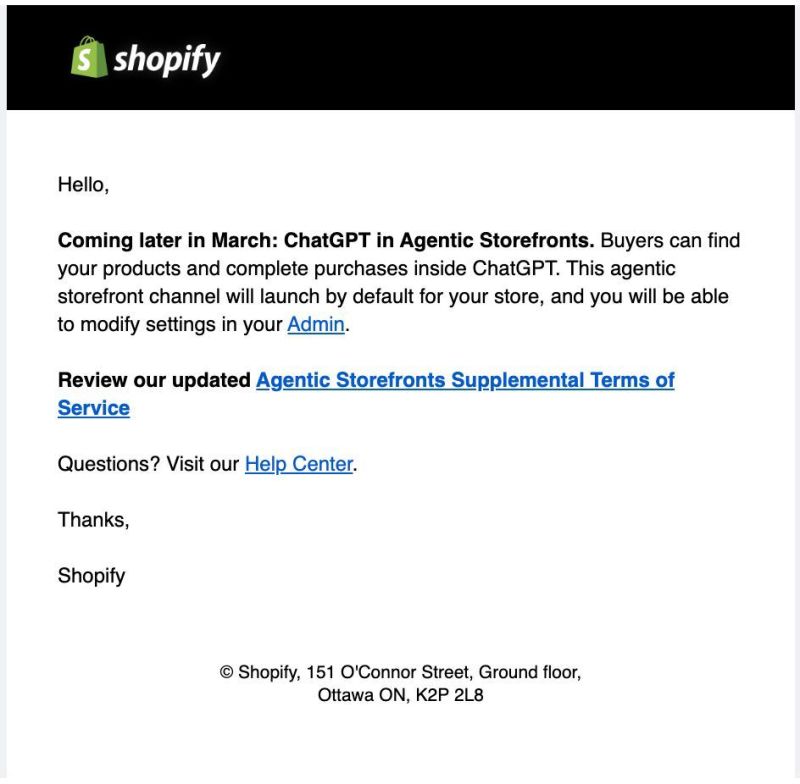
Email sent by Shopify to merchants in March 2026
The most striking detail: all Shopify stores are now surfaced on ChatGPT by default. Merchants do not need to opt in. This is a direct result of the Shopify-OpenAI partnership, where OpenAI uses Shopify's commerce infrastructure rather than building its own.
"It's going to happen pretty slowly and then all at once."
Shopify Winter '26 Edition Highlights
Agentic Storefronts
Every store readable by AI agents, live on ChatGPT by default
Shopify Catalog
Centralized product data layer optimized for agent consumption
SimGym
Simulated agent environment for testing how agents interact with your store
Knowledge Base App
Lets merchants define brand context that agents can reference
Agentic Plan ($0/mo)
Free plan for non-Shopify merchants to list products for agent discovery. Shopify takes a transaction fee instead of a subscription.
Shop Pay as Trust Layer
One of the underappreciated elements of Shopify's agentic strategy is Shop Pay. When an AI agent recommends a product and the consumer decides to buy, the transaction still needs a trust layer. The consumer needs to know their payment is secure, their data is protected, and they can return the product if it does not work out.
Shop Pay already has over 150 million users and processes billions in GMV. In agentic flows, Shop Pay becomes the default checkout method. The consumer does not need to enter payment details on an unfamiliar site. They tap Shop Pay, the transaction completes, and Shopify handles the rest.
This is exactly what OpenAI lacked. Building a payment and trust infrastructure from scratch is a multi-year, multi-billion-dollar problem. Shopify already solved it. By plugging Shop Pay into agentic storefronts, Shopify creates a closed loop: agent discovers product via UCP, consumer pays via Shop Pay, Shopify handles fulfillment and post-purchase.
5 Merchant Imperatives
Based on Harley's talk and the broader market signals, here are five things every merchant should be doing right now.
Treat agentic as a channel, not a feature
Just like you have a social strategy and a marketplace strategy, you need an agentic strategy. Assign ownership. Track metrics. Allocate budget.
Fix your product data now
Agents surface products based on data quality, not ad spend. If your titles are vague, your descriptions are thin, and your attributes are missing, agents will skip you. Invest in structured, detailed, accurate product metadata.
Compete on merit, not reach
The agentic model rewards the best product for the query, not the biggest marketing budget. Focus on product quality, customer reviews, transparent pricing, and clear differentiation.
Implement UCP and understand ACP
If you are on Shopify, agentic storefronts handle UCP for you. If you are not, start implementing it manually. Also monitor the emerging Agent Commerce Protocol (ACP), which may become the complementary standard for agent-to-agent transactions.
Double down on brand
When agents mediate discovery, brand trust becomes even more important. Consumers will still want to buy from brands they recognize and trust. Invest in brand building, community, and direct relationships. The brands that win in agentic commerce will be the ones that agents recommend and consumers accept.
Harley's talk painted a clear picture: Shopify is betting its future on being the infrastructure layer for agentic commerce. The UCP, the hub-and-spoke model, the Agentic Plan for non-Shopify merchants, and the OpenAI partnership all point in the same direction.
But optimism aside, there are real gaps in this vision. Data quality requirements that most merchants cannot meet, post-purchase experiences that agents cannot handle, checkout limitations that strip away upsells and bundles, and platform lock-in concerns that the Agentic Plan quietly introduces.
In the next post, we will break down what is actually wrong with Shopify's agentic commerce approach: the limitations, the missing pieces, and the opportunities that Shopify cannot solve natively.