1. The Generative Engine as a Function
At its core, a generative engine is a mapping from a user query to a response:
where qu is the user's query, PU is the personalization context (such as location or intent history), and r is the generated response (structured text with inline citations).
Unlike a classical search engine that ranks documents, a GE synthesizes an answer by reading, reasoning, and rewriting through multiple neural modules.
2. The Multi-Model Pipeline
A modern GE is a composition of specialized subsystems:
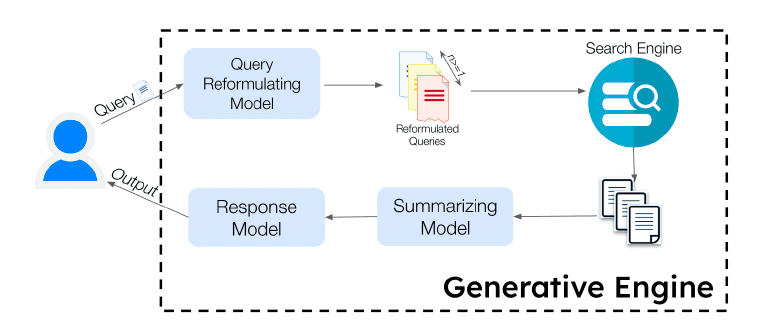
2.1 Query Reformulation (Gqr)
Expands qu into semantically diverse sub-queries:
2.2 Retrieval Engine (SE)
Fetches a ranked set of sources using information retrieval:
2.3 Summarization Model (Gsum)
Compresses each document into a short, citation-ready summary:
2.4 Response Synthesizer (Gresp)
Constructs the final response:
3. Sentence-Level Structure and Citations
Let the response be a sequence of o sentences:
Each sentence ℓt is annotated with a citation set Ct ⊆ S.
For attribution integrity:
- Citation precision is the fraction of citations that truly support ℓt.
- Citation recall is the fraction of factual claims in ℓt that are cited.
4. Quantifying Visibility Inside a Generative Response
Visibility in a generative engine is embedded within the synthesized text.
4.1 Word-Share Impression
4.2 Position-Weighted Impression
4.3 Subjective Impression
Impsubj(ci) = Σk wk · Subjk(ci)
5. Optimization Objectives
The generative engine optimizes for expected answer quality:
Content creators, on the other hand, optimize visibility:
This dual optimization forms the basis of Generative Engine Optimization (GEO).
6. Measuring Visibility Change
After a content update, visibility improvement is defined as:
Empirically, factual enrichment and structural clarity yield the highest lifts.
7. Probabilistic Model of Answer Generation
Each GE stage is a stochastic mapping:
The overall likelihood of producing r given qu is:
8. DAG Representation
Each node performs a transformation, and each edge defines a conditional probability distribution.
Critical hyperparameters include fan-out size n, retrieval depth k, summarization ratio α, answer length L, and citation density dc.
9. Why GEO Works
Optimized content affects two conditional probabilities:
By improving both retrieval likelihood and synthesis attribution, GEO enables even lower-ranked sources to capture higher visibility in final LLM answers.
10. Multi-Turn Extension
For conversational engines, context history H = ⟨(qt, rt)⟩ conditions the next response:
This defines a temporal generative process that continuously updates latent context distributions.
11. Computational Characteristics
If k is the number of retrieved sources and L is the total token length, then inference cost is approximately:
Summarization is linear in document size, while synthesis scales quadratically with attention, explaining why most engines restrict k ≤ 5 and compress summaries aggressively.
12. Summary
| Component | Role | Form |
|---|---|---|
| Query Reformulation | Expand queries | Q1 ∼ p(Q1 | qu) |
| Retrieval | Fetch sources | S ∼ p(S | Q1) |
| Summarization | Compress docs | Sum ∼ p(Sum | S) |
| Synthesis | Generate response | r ∼ p(r | qu, Sum) |
| Impression | Measure visibility | Impwc, Imppwc, Impsubj |
| Optimization | GE utility | maxr E[f(Imp, Rel)] |
Generative engines are probabilistic pipelines that optimize for contextual answer quality under strict latency and memory constraints.
Understanding their mathematical structure is essential to improving your brand's visibility within AI-driven ecosystems.
Want to know more about how Rankly is built to solve your visibility-to-conversion funnel?
Schedule a Demo